
Editor's Picks

MEXICO: A WORK IN PROGRESS

Editor’s note: The very same day I arrived in the city of Monterrey the local news reported that police had found six severed heads in the trunk of a car parked at a gas station. I was in Monterrey to lead a seminar and workshop on Service Management to a local group of business men and women over the coming three days and this was hardly the welcoming I was expecting.

I have traveled widely throughout Mexico and the city of Monterrey in particular for more than twenty years on business and have followed the nation’s gradual descent into violence and death. The depredations of the drug cartels in recent years, however, bear witness to a country which despite its potential and promise is on the verge of perhaps never returning from its infernal evil.

In the last decade alone, nearly two hundred thousand people have lost their lives many of whose bodies have been found horribly dismembered strewn on streets or hanging from bridges. In addition, people numbering in the tens of thousands are now classified as desaparecidos or people who have mysteriously gone missing.

The usual rationalization one hears in Mexico – aside from pointing the finger at America’s insatiable appetite for opioids – is that the violence is self-contained as drug cartels struggle with each other for supremacy in a local area. This is a naïve if not a feeble attempt at putting a good face on a grievous problem. Yes, the bulk of the dead are members of one cartel or another but police officers and military personnel have also been killed in ambushes and skirmishes with the heavily armed cartels. In addition, many innocent civilians, including tourists and foreign workers, have either been caught in a cross fire or purposely targeted so as to intimidate the local citizenry.

The plague that is the Mexican drug war seems no longer confined to the handful of states that have historically been a hotbed of crime. More and more drug cartel violence has been in evidence in tourist areas such as Acapulco, Cancun, Los Cabos, and Playa del Carmen. This has to be of concern to government officials as tourism is one of the largest sources of foreign exchange for the country. Still, Mexico is the most frequent destination for Americans with over thirty-five million tourists visiting the country in 2016.

President Enrique Peña Nieto, of the historically corrupt Institutional Revolutionary Party (PRI), sought an accommodation with the drug cartels. His approach was to push the problem down to local law enforcement. In contrast, Nieto’s predecessor, President Felipe Calderon saw the problem as one infringing on national security and one that required a more kinetic approach in seeking out and eliminating the perpetrators.

Nieto’s approach speaks for itself, however, as bloodshed has spiked to record levels. Homicides are now averaging in excess of 2,000 per month and will likely exceed 30,000 in 2017. That works out to about 25 homicides per 100,000 population. The comparable figure in the United States is about 5 per 100,000. Americans traveling in Mexico are especially at risk as approximately 600 souls were killed in the period 2009 to 2016. This makes Mexico the number one killing field for Americans, by far, of any country in the world.

WHY DO BUSINESS IN MEXICO?

In the 1990’s, I employed approximately one hundred workers in a software development center in Monterrey. We chose Monterrey – the second largest metropolitan area in Mexico with over four million inhabitants and the highest per capita income in the nation – for our development center because the city is a financial, commercial, and industrial powerhouse. The city is cosmopolitan with important museums, and an abandon of chic hotels, malls, boutiques, and restaurants. The city’s infrastructure of roads and highways is above average albeit in much need of repair. Telecommunications is adequate but remains hamstrung by the presence of a nation-wide duopoly that chills foreign carriers from entering the market. It is comforting, but also rather unsettling to see the ubiquitous presence of armed military personnel patrolling the streets.

The city made logistical sense to our company because it was proximate to our hubs in the West and Midwest of the United States, and to markets in South America. Mexico City, a huge market in its own right, with over twenty million population and the nation’s financial, government, and administrative center, is an hour and a half by plane. The icing on the cake, however, was the fact that Monterrey is blessed with some of the finest institutions of higher learning anywhere.

The Monterrey Institute of Technology, known as el Tec, is a world class university known for its STEM – Science, Technology, Engineering, and Math – undergraduate and graduate programs as well as its programs in business and healthcare. Most of the graduating students are not just highly competent in their own disciplines but most have a working knowledge of English. Furthermore, the workforce embraced with enthusiasm our service mission which in a few words is encapsulated as “customers are first.” Without a doubt, the young men and women who worked for us were some of the best in our employ anywhere in the world.

The software development center proved to be a big success. President Ernesto Zedillo visited the site, gave a rousing speech of praise and spoke of the ushering of a new era in Mexico.

IT’S GOING TO TAKE MORE THAN MAQUILADORAS

Mexico’s GDP ranks 15th worldwide at $1.1 trillion and is within striking distance of countries such as Spain, Australia, and even Russia. Two thirds of the nation’s GDP is comprised of services such as banking and tourism. At a macro level, Mexico has the potential to vault higher in the GDP rankings. The country is blessed with ample natural resources, ports of entry in the Pacific and Atlantic Oceans, a young and industrious work force, an abundance of new graduate engineers, and close ties to the largest economy in the world. Mexico’s economy will have to grow, however, at a more aggressive clip than it has experienced over the recent past. The growth in GDP over the last ten years, for example, has been virtually nil.  By all accounts, a developing nation like Mexico should sport a very lofty growth rate. GDP on a per capita basis, too, is bleak: Mexico ranks 72th among all nations and is immediately behind Russia.  By comparison, Australia’s GDP per capita is nearly six times that of Mexico.

Mexico’s maquiladoras – export based and usually foreign-owned manufacturing companies – are booming due to the nation’s modest labor rates. In addition, The North American Free Trade Agreement (NAFTA) has given Mexico access to the huge United States market under very favorable trading terms. But further growth is going to depend on whether the United States has any appetite for continuing to endure an annual trade deficit of roughly $70 billion.

Entrepreneurial new job starts, especially in knowledge industries, must remain a top priority to smartly diversify and spur the economy. To that end, Mexico needs to develop its private equity and venture capital ecosystem which currently is paltry. More fund managers, more capital, and, in the end, more confidence needs to come into the system to give a shot in the arm to young and innovative new businesses and industries. Commercial credit both short and long term is prohibitively expensive and therefore not a viable alternative for most development stage companies.

My experience here is telling. I had a client with a terrific and viable business plan in the e-learning space. The business had a modest revenue stream and was led by a team of very competent and experienced managers. The startup was headed by a CEO with a doctorate in computer science. Potential investors in the U.S. were rightfully wary of investing in Mexico and risk losing the protections afforded minority investors in the United States. As an alternative, I approached the CEO to re-domicile the business in San Antonio but that proved to be a non-starter for a variety of personal reasons. In the end, we were unable to find investors in Mexico who would belly up to the risk-reward profile of a technology-based startup.

Other precautions must be heeded by the foreign investor seeking to do business in Mexico. An early bridge which must be crossed is how to denominate a contract. We always insist on dollar denominated deals given the Mexican peso’s historically erratic nature – the peso has declined 100% in the last ten years and is now at twenty pesos to the dollar – but successfully negotiating all of the relevant terms is not easy. Also, contract negotiations can prove to be arduous as business practices which might appear to be matter-of-fact to the local businessman seem opaque to us. In one instance, our Mexican partner’s organization was so labyrinthine that it was difficult for us to fix a point of liability in the event of a breach. Mexico is not a common law jurisdiction and therefore expert legal advice is mandatory in order to interpret laws enacted by the various legislative bodies. Finally, corporate financial statements in Mexico can diverge significantly from GAAP standards and will normally require financial and tax advice to harmonize. These and other institutional and cultural reforms are the order of the day if Mexico despite all of its promise and potential is to clamber out of its current economic malaise.

Share

SERVICE MANAGEMENT MUST COME TO THE WORLD OF NON-PROFITS

Editor’s note: A benefactor to a local opera house pledges a seven-figure donation over four years only to find that the head of the opera insists on the entire donation be made in one shot right then and there. Wisely, the donor ignores the strong-armed tactic and walks away leaving the charity empty handed. Shortly thereafter the donor tells all of her friends of the charity’s seedy behavior. On another occasion, the same opera house invites Grand Benefactors to attend a private recital given by New Zealand soprano Kiri Te Kanawa. No mention is made of the cost as it is understood by members that this is a perk of their patronage. A week later, members receive an invoice for $20,000. Not surprisingly, many members see the ruse for what it is and refuse to pay.

Charities have customers but one would never know itfrom the way they render service to those who are their lifeblood: their donors. In fact, the service being dished out by a lot of charities, including many with marquee names, rivals the worst service to be found in the commercial world. That has to change if donor churn is to be mitigated and donations kept from drying up. The supply chain consequence of a charity’s service indifference, of course, is that those most in need will suffer the most.

I was approached by an entourage fromThe American Red Cross seeking to build a modern aquatic center for disadvantaged children in South Florida. In our meeting, the lead person from the Red Cross team said that a potential donor – we’ll call him donor B – had agreed to put up half the money if I put up the other half. In due diligence, I contacted donor B only to find that he never made such a representation. In the end, we both walked away in disgust.

My discomfiture is small potatoes, however, compared to the American Red Cross’ dreadful behavior after the catastrophic earthquake which struck Haiti in 2010 killing 100,000 people. The charity did a land-office business by raising $488 million mostly by tugging at the heart strings of Americans who were unaware that the charity couldn’t possibly spend all of the money it had raised. Four years after the disaster, the charity had spent a mere pittance of the money raised by building a hand-full of homes. Much of the charity’s spending went to 50 partner organizations which naturally took their own cut for administrative expenses. In one case, the American Red Cross paid the International Federation of the Red Cross (IFRC) $6 million to subsidize rent for people who had been living in tents. The IFRC, of course, took their 26% for administration while the American Red Cross took an additional 9% for program management. In another case, the American Red Cross took a full 24% for costs associated with another group’s efforts.

All of this led the charity’s former chief of the Haitian shelter program,Lee Malany, to turn in his resignation after indicating that agency officials “did not seem to have any idea how to spend millions of dollars set aside for housing.” Shamefully, however,the charity’s CEO, Gail McGovern, brushed aside all of the criticisms and is still employed in return for a compensation package that is well in excess of $500,000 a year. A generous pay package indeed given the executive’s bumbling performance.

THE FOX IS GUARDING THE HEN HOUSE

There is no federal agency with jurisdiction over charities. The Federal Trade Commission (FTC) does prosecute cases but only when a charity brazenly behaves more like a commercial enterprise for the benefit of its founders but those cases are rare as they are time consuming and expensive to litigate. Moreover, any proposal to expand the agency’s regulatory portfolio to oversee charities would most likely be met by opposition from those who might correctly assert that the agency has its hands full regulating commercial enterprises as it is.

Jurisdiction over charities, therefore, falls to the states which obviously creates a virtual Tower of Babel of rules and regulations which is exploited by devious and unscrupulous operators. The state of Florida is notorious in this regard domiciling some of the worst charity abusers in the nation.

Effective oversight of charities is a Sisyphean task in any event as there are over one and a half million charities in the nation raking in over $350 billion in donations annually. And, unless stiff standards are set which can be enforced to aggressively cull the number of unworthy charities corrupt entrepreneurs will continue to crowd at the horn of plenty.

There are charity watchdogs such as the BBB Wise Giving Alliance, Charity Navigator, and Charity Watch that occasionally call out the bad actors but again these groups can only scratch the surface of the bewildering number of charities operating in the marketplace. These groups focus on financial improprieties and that is well and good but I would also like to see, for example, the American Customer Satisfaction Index (ACSI) apply its rankings to charities. And, although I would not want to see the emergence of yet another federal bureaucracy it might be helpful, instead, if the states could harmonize the plethora of disparate rules and regulations currently in place. Until such time, the customer, the donor, must bear the brunt of knowing how his money is being put to use.

CAVEAT EMPTOR

I once got a call from a woman who runs the local Cystic Fibrosis chapter. Would I be willing to give a donation? Sure, I said, would you please send me a copy of your most recent Profit and Loss Statement? “Well, I’m not sure I have one,” the woman said. Fine, then why don’t you send me a copy of the charity’s IRS Form 990 (this form, Return of Organization Exempt from Income Tax must be filed by charities grossing more than $50,000 a year). Okay, Mr. Pupo, let me see what I can do. I’m still waiting.

Cases of charity abuse are rampant and some are nothing less than grotesque. Here is but a sampling that has been made public:

  • The Cancer Fund of America located in Knoxville, Tennessee boasts that it is at the forefront of the fight against cancer. The charity, it says, provides aid to anyone suffering from over 240 types of cancer. The charity also states that it drives cancer victims to chemotherapy appointments, pays for groceries, and provides medication to suffering children. This charity from 2008 to 2012 raised an astounding $187 million from unwary donors. Sadly, only 3% went to direct aid. The charity did, however, spend generously on salaries, perks, cars, and trips. Founder James T. Reynolds Sr.’s son, for example, garnered $371,000 in 2010 as CEO of the affiliated Breast Cancer Services. The FTC did catch up to this bunch and was able to successfully reach settlements against two affiliates of the charity by arguing that the charity was in fact a commercial operation organized to defraud the public.
  • The Kids Wish Network in Holiday, Florida raised an eye-popping $127.8 million in donations for kids with life-threatening conditions. Incredibly, only 2.5% of the money raised went to help the children.
  • The International Union of Police Associations AFL-CIO, not to be outdone in its meager investment of those in need, spent a miserly .5% of its $57.2 million in total donations on direct aid. Of the total amount raised, $41.4 million went to companies that helped the organization raise money.
  • Connecticut-based National Veteran Services Fund devoted less than one-third of the $8.6 million it spent in fiscal 2015 on its charitable programs and nearly 69% on fundraising.
  • In the United Kingdom, two of Prince Charles’ charities have been tarnished by impropriety. One, a charity set up to sell the Prince’s watercolors took in over $5.5 million dollars over a two-year stint without dispensing any monies to the needy. A second charity, The Prince’s Foundation for Integrated Health, had to be shuttered after the foundation’s finance director was found to have embezzled over $300,000.

Philanthropy in the United States operates much like a cartel. Of the one and a half million charities in the nation roughly 25% of all donation dollars are concentrated in the top 400 nonprofit organizations. This doesn’t bode well for the smaller, more efficient, and younger nonprofits. The American Red Cross, hardly a paragon of efficiency, has over 30,000 employees on its payroll and countless more contractors. Clearly, a donor dollar will have little stretch in a bureaucracy this large. Big name charities do have huge budgets, and employ sophisticated fundraising techniques. A donor who fails to do his research, therefore, will likely fall prey to the onslaught of media advertising which only the big boys can afford.

A CALL FOR TRANSPARENCY

I would like to see all charities be mandated – who is to do the mandating is a much thornier question but it might best be in the hands of the organization’s Board of Directors – to publish an annual report which would include the following information as a minimum:

  • A copy of the organization’s mission statement.
  • A reaffirmation of the charity’s commitment to donor data privacy.
  • Customer satisfaction ratings compiled by an independent third party.
  • Disclosure of all litigation and formal consumer complaints.
  • Names and contact information of all officers and board members.
  • All executive officer and board member compensation.
  • A detailed Profit and Loss Statement clearly stating the amount and percent spent on fundraising, and on relief programs.
  • A description of the previous year’s relief programs.
  • A link to electronically access IRS Form 990.
  • The amount of financial aid distributed domestically as well as internationally.

No singular piece of the aforementioned information can illuminate a charity’s malfeasance. The donor, therefore, must seek as much of the above information as he can get his hands on unless the prospective donation constitutes a trivial sum. A charity that fails to pony up the requested information should be met by a donor’s commensurate failure to pony up any funds.

Share

A SERVICE ECONOMY WITHOUT SERVICE: ANOTHER GREEK TRAGEDY IN THE MAKING

Editor’s note: The service economy of Greece accounts for roughly 80% of GDP. So, one would think that with so much riding on this crucial sector of the economy that the nation would excel in its delivery of service. Alas, that is not the case. Service across the board in key industries, from energy, to telecommunications; from transportation, to retail, to tourism is mediocre at best. Civil servants, many in office for their patronage to one political party or another, are largely indifferent to the needs of citizens, are untrustworthy, do not take their jobs seriously, and excel at finger pointing.  The one bright light in this very dark tunnel is international shipping where Greece is the preeminent power with control over nearly 20% of the world’s merchant fleet. That aside, however, Greece has become a philistine nation devoid of its former elegance.

Greece faces profound impediments that get in the way of delivering even the most basic service to customers. Bureaucratic inefficiencies, fiscal indiscipline, corruption, vandalism, serious crime, untrained workers, haphazard urban planning which routinely desecrates the environment (Greece, unique among modern nations, does not have a comprehensive land registry which has led to rampant illegal building construction, and which accounts in part for the fire that killed nearly 100 people in the coastal village of Mati in July, 2018), regulatory overreach, confiscatory tax rates, and unions run amok all set the stage for what is perhaps the thorniest problem facing the service sector: Cultural hang-ups which confuse serving the public with servility to a master – the chip-on-his-shoulder, ill-mannered, and snippy attitude of many Greek service workers leads many consumers to simply turn their heads in disgust. At best, it is doubtful that the service sector in Greece will lead the country out of its profound economic malaise in the near term. At worst, the combination of these factors has the potential to arrest any hope the nation might have of clambering out of its economic black hole. And, if the service economy doesn’t get it in gear the nation is likely to sputter for a long time to come: exporting pistachios, feta, and olives simply will not pick up the slack.

IS TOURISM THE ANSWER?

Tourism, the bread-and-butter component of the service economy in Greece, accounts for nearly one-sixth of the nation’s GDP and one in five employed workers. Over thirty million foreigners – including passengers on cruise ships – visited Greece in 2018. But Greek tourism is, by and large, a magnet for cheap vacationers: something like 40% of all visitors to Greece come from the former Yugoslav Republic of Macedonia (FYROM) – which leads the pack with over three million visitors or one and a half times the upstart nation’s population – Serbia, Bulgaria, Turkey, Romania, Albania and Poland. The numbers speak for themselves: the average receipts per arrival to Greece amounts to about $500.

The affluent and educated tourist does not countenance a vacation spot for he and his family where he has to contend with dumpsters filled to overflowing for weeks, traffic nightmares, ubiquitous and vile graffiti sprayed on building and monument walls, stray dogs and cats everywhere, gypsy panhandlers, throngs of rowdy teenagers loitering in public and private spaces shouting obscenities at the top of their voices – police officials unable or unwilling to restore order – barroom brawls, and worse. The beating deaths of two tourists, in separate incidents, on the island of Zakyntos is the most graphic example of the shambles that the Greek tourist economy has become. The rule of law and order has been cast to the wind as was further evidenced when the chief of the Athens Traffic Police was attacked by a gang of thugs.

In contrast, another tourist hotspot, Dubrovnik, Croatia sited beautifully on the Eastern Adriatic Sea sports castle, building, and church walls that are pearly white and devoid of any graffiti. Amazingly, the city has recovered fully from the devastation that was visited upon it during Croatia’s war of independence waged between 1991 and 1995 against the Serbian-dominated government of Yugoslavia. The airport is ultra-modern and clean.  There is no litter or plastic bottles seen on the street and the city empties dumpsters seven days a week. Service workers are hospitable, reasonably fluent in English, and friendly. The city, as a whole, moves about with a sense of quiet purpose.

To be fair, some restaurants and hotels in Greece excel in service but they are the exception. Also, there are magnificent resort locations to attract the affluent tourist. The Romanos Resort in Costa Navarino in Messenia, on the Peloponnesian peninsula is a magnificent self-contained property with beaches on the Ionian Sea, outstanding restaurants, and golf courses. On the island of Crete, the standout resort is the Elounda Beach Hotel.  Also, a self-contained resort it is on the northeast coast of Crete sited on the aquamarine waters of the Mediterranean Sea. The Elounda Beach Hotel is a favorite of well-heeled Russians (restaurant menus and marketing brochures are printed in Cyrillic among other languages). The Danai Beach Resort in Sithonia, a peninsula in Chalkidiki, in the northeast part of the country is surrounded by magnificent forests. The resort itself exudes serenity, displays sandy Aegean beaches and is expertly managed.  These three resorts are standouts but, again, they are the exception to the rule.

The contraction of the economy which began at about the time that the Lehman Brothers collapse in 2008 rocked the worldwide financial markets, and the severe austerity measures imposed on this small nation of eleven million people by the Troika – the International Monetary Fund, the European Central Bank, and the European Union – has clearly made things worse. But slapdash service is nothing new.

With so much riding on tourism, Greece nonetheless ranks 24 out of 136 nations – a generous ranking in light of the current discussion – in the Travel and Tourism Competitiveness Index for 2017. This index measures a country’s ability to sustainably develop a business in the tourism sector. If the newly appointed President of the Greek National Tourism Organization, Angela Gerekou, a former actress who studied architecture, and whose experience in tourism is paper-thin, should be given a mandate it should be to elevate Greece solidly in its ranking of this important index.

GOVERNMENT POLICIES INFLICT CONSIDERABLE DAMAGE ON THE SERVICE ECONOMY

The tax regimen is as oppressive as they come and is perhaps the principal culprit making Greece one of the leading tax cheats in Europe: the corporate income tax rate is set at 26%; the individual income tax rate at 46% for incomes over $40,000 is clearly confiscatory; the VAT tax rate is 24%; and the social security tax rate is set at 42%. The capital gains rate is a modest 15%. Real property taxes amount to a not too well disguised subterfuge because although the rates are modest the government exaggerates the value of the property and therefore the amount of taxes due. Furthermore, property taxes assessed in one community can be spent by the national government in another community. It would be as if, say, a Chicago homeowner saw his property taxes spent in Miami. The inheritance tax is progressive rising to 10% for estates valued at over 300,000 euros with a 150,000 euros exemption. This last, in combination with a paucity of financing opportunities to rehabilitate long neglected properties, forced approximately 135,000 Greeks to turn their backs on their inheritances in fiscal 2017.

The regulatory climate in Greece is a further abomination. According to the Organization for Economic Cooperation and Development (OECD), the regulatory climate in Greece is nearly the most restrictive among member nations – only Turkey, Greece’s bellicose neighbor to the east, has a more restrictive regulatory climate.

Fixing the nation’s balance sheet remains a top priority but unless opaque, obsolete, and complex regulations are streamlined or, better, eliminated all of the financial housekeeping in the world will be for naught. Two anecdotal, albeit powerful examples, born of first-hand experience should drive the point home: 1) a seaside taverna owner on the island of Crete who owns a small fishing vessel is disallowed from selling his own catch at his own restaurant. The fish he sells at his taverna must come from a distributor; 2) a woman on the Ionian island of Lefkas who owns a small-footprint supermarket finds it unlawful to sell figs from her own orchard at the supermarket. State auditors demand to see an “invoice” evidencing the purchase of the figs she sells. Many more examples of regulatory pettifoggery abound.

Now comes the deleterious effect of the Middle East refugee crisis adding a toxic element to Greece’s cocktail of woes. The crisis, was born of German Chancellor, Angela Merkel’s open border conceit and financial leverage over a diffident Greek government but it is aggressively fueled by Turkish smuggling bands. Many Greek islands of the Eastern Aegean – Kos, Lesvos, Samos, and Chios, have been particularly hard hit – have been turned into public sewers by the over one million migrants which have overrun historically pristine beaches, desecrated Christian crosses, complained about Greek food and free accommodations, caused civil disturbances, and helped fuel a surge in prostitution. In the light of all of these developments, it remains to be seen whether tourism can become a sustainable engine of growth over time.

CAN ANYTHING BE DONE?

The ancient Greeks – and until not so long ago most Greeks – were strong adherents of the precept of philoxenia. The term, nominally, translates into English as hospitality. But the meaning of the term runs much deeper than that. In its full meaning, the term is understood as the attitude that a host exhibits in being friendly, generous, courteous even loving to strangers whether they be from the next village or the next continent. In my experience, philoxenia has died on the vines of economic, social, cultural, and political decay.

Greece enjoys sensational seascapes, landscapes, archaeology, and history. But for tourism to snap back as an important catalyst for the growth of the economy it will take much more than that. A key government priority, in partnership with private enterprise, must be to break the back of the culture of bad service which has become institutionalized in Greece. This will be a long and hard slog but it can be accomplished through education and training programs, as well as through incentives and penalties designed to ensure the necessary behavior modification of service providers whether they be public or private. It must be said, too, that customers and especially foreign tourists have a role to play here by demanding a higher level of service than the nation is dishing out.

A second priority is the rebuilding of the nation’s infrastructure, particularly on the islands, to include upgraded airports, roads, ports, transportation, telecommunications (among OECD countries, Greece ranks last in fiber optic broadband penetration), waste haulage, water supply (summer customarily brings water shortages to many islands), and sewage systems. Examples of how the nation’s infrastructure is unable to cope with its own success as a tourist destination abound: 1) On the island of Mikonos, the peak tourist season attracts tens of thousands of tourists. Yet, the number of available taxi cabs number roughly two dozen. Simply put, a tourist arriving at the airport will find it virtually impossible to hail a cab; 2) On the island of Samothraki, over a thousand visitors were stranded for days due to mechanical malfunctions on multiple ferries; 3) Santorini has become insufferable for the individual traveler. Over two million tourists visit the island each year much of it comprised of tour groups. The picturesque village of Oia, with its view of the caldera, is a nightmare for the individual tourist who has to fight his way through knots of rowdy organized travel groups. A recent phenomenon which has exacerbated the island’s inability to deal with the onslaught of tourists are wedding-tourism groups, mostly from Asia, which for hours on end will monopolize iconic photo shoots.

It remains to be seen how long the well-heeled tourist endures these arduous conditions before exploring alternate vacation destinations. Clearly, the country’s topography with its many islands makes the task far more difficult and expensive than if it were dealing with a single land mass. But that is the hand that Greece has been dealt and its vistas are what makes the nation unique in all the world.

It isn’t clear how the nation’s financial distress will allow it to finance the vast improvements to infrastructure that are sorely needed. Improbably, however, the country found a way to spend up to $2.4 billion to upgrade its F-16 fighter fleet. This is a follow-up to a previous deal which cost taxpayers in excess of $2.5 billion for German submarines. That deal was severely marred when investigators found the Defense Minister, Akis Tsochadzopoulos, guilty of taking bribes of up to $120 million.

The nation’s recalcitrant service culture and its crumbling infrastructure, among other factors, stand in the way of attracting not just affluent tourists but also, foreign investment. It is no surprise that Greece currently ranks dead last in Europe in attracting foreign capital as a percentage of GDP. And, according to the Economic Freedom Report published by the Fraser Institute for 2016, Greece ranks 107th out of 162 nations in the world. This ranking, a drop of twenty-one places from 2014, puts Greece in a tie with China and Swaziland  when measured on the basis of five broad metrics of economic freedom. Clearly, a foreign investor seeking political and economic stability, market size, transparency, above-average labor skills, conformity with the rule of law, a pro-growth tax regimen, and regulatory compliance will look to risk his capital elsewhere as they are scarce commodities in Greece.

As a philhellene, it saddens me to say that I am not optimistic that anything positive will emerge in Greece anytime soon. The nation now seems devoid of the ancient cultural value of axioprepia so critical to its self-esteem and to the image it projects on the world’s stage. At the height of the financial crisis the negative stereotyping of Greeks clearly intensified but the stereotyping always had a grain of truth: the financial meltdown simply proved to be an added accelerant. A citizen – a community, a nation – is axioprepis if he behaves with dignity such that he is seen by others in a good light in all that he does. That critical cultural value, I’m afraid, has become obsolete.

WHERE IS THE LEADERSHIP?

The former Prime Minister of Greece, Alexis Tsipras, was unabashed in his praise for Che Guevara (his son’s second name, Ernesto, is a tribute to the genocidal maniac of the Cuban communist revolution); Venezuelan Dictator, Hugo Chavez, leader of a failed coup attempt in 1992, whom he, mind-numbingly attributed as, “an inspiration for the ideas of democracy…” and whose funeral he attended in 2013; and Fidel Castro, whose funeral he also attended in 2016. Service, capitalism, and free markets were the last things on Tsipras’ mind. His fingerprints are all over the mess that Greece now represents.

It wasn’t so long ago that Mr. Tsipras’ model of a sovereign nation’s success was his idol Chavez’ Venezuela, a country made all the worse by the electorally questionable accession of Chavez’ more plastic but just as ruthless successor, and former bus driver, Nicolas Maduro;  a country which has witnessed over two million citizens exit the nation in despair; currently riven by a world-leading homicide rate per capita; with widespread shortages of food, water, electricity, and medicines; government oppression and quite literally on the verge of anarchy – despite having the largest proven oil reserves in the world. Mr. Tsipras may no longer be Prime Minister but he still heads the radical-left Syriza party which garnered more votes during its last election loss than anyone expected and which is likely to remain a thorn in the side of the new government.

Service, financial, and structural problems in Greece will require a largely free-market solution. And, it remains to be seen whether the new government under Prime Minister Kyriakos Mitsotakis, who is steeped in both business and politics, can put Humpty Dumpty back together again.

Share

REMEMBERING THE INFAMY OF MR. OBAMA’S VISIT TO HAVANA

Editor’s note: If a government’s mission is to be of service to its citizens, President Obama’s less than transparent visit to Cuba in 2016 betrayed the citizens of the United States. Mr. Obama’s visit was stagecraft meant to signal to the unquestioning that only he has a grasp of right and wrong. To his American audience he left the impression that a little fence-mending would make the Castro regime more amenable to democratic reforms. Simply book a cruise on Royal Caribbean or a flight on JetBlue to Havana and voila Cuba’s ills will wither. Left unsaid is that the Cuban government pockets the hard currency from such transactions and in turn pays its workers in worthless pesos – in contrast, in 1958 the Cuban peso and the U.S. dollar traded on a par. Meanwhile, a near-universal economic deprivation continues to grip the nation.

President Obama’s Keynote speech was delivered at the Gran Teatro, a storied music hall confiscated by Fidel Castro. Mr. Obama’s performance was a classic example of dramatic irony ancient Greek theatergoers would have been proud of as the audience knew exactly what was going on even if the main character did not. The gentlest rebuke of Cuba’s sixty-year dictatorship would have served to remind the world that the island nation is in a ramshackle state courtesy of the Castro brothers. 

Cuba’s economy was one whose productivity and services rivaled those of Germany and Japan. Cuba, pre-Castro, had a large middle class, low infant mortality (lower than France or Germany), and an 80% literacy rate. Havana, especially, enjoyed amenities, conveniences, and luxuries more in keeping with a major American city. In 1958, for instance, Havana had more movie theatres than any other city in the world. Cuba ranked fifth in the Western hemisphere in per capita income, third in life expectancy, and second in per capita ownership of automobiles, telephones, and television sets. Cuba’s income distribution was hardly that of a banana republic but of a progressive modern nation. Healthcare was widely available to the underprivileged. Today, the propaganda that all citizens have access to free healthcare is meaningless when one considers that the government mandates who will receive medical care and when, that pharmaceuticals are in short supply, medical equipment is decrepit, and hospitals and clinics are rickety. Physicians, on slave wages (about $65 a month), somehow manage to keep the system lumbering along. Furthermore, it is widely acknowledged that the government manipulates medical outcomes data, especially on infant mortality, to give the appearance of its being a modern developed nation. Physicians, for example, aggressively misrepresent neo-natal deaths as late fetal deaths, and engage in coercive abortions all intended to conceal the true rate of infant mortality while boosting life expectancy numbers.

As to education, Cuba had near-universal public education and outspent every European country and the United States on education as a percent of GDP. Pre-Castro, and as a first in Latin America, Cuba introduced the minimum wage, and the eight-hour work day.

In sum, before Castro’s repressive regime came along, Cuban citizens were educated, had decent healthcare, were entrepreneurial, and most importantly were free to come and to go. The Cuban economy, based largely on tourism and services was thriving, before suddenly imploding at the hands of the Castro regime. Mr. Obama did a great disservice to the citizens of both the United States and Cuba by remaining mum on the nation’s violent and retrograde slide over sixty years.

THE CUBAN MARXIST SYSTEM IS IMPERVIOUS TO OLIVE BRANCHES

The group of Cuban-American businessmen who accompanied Mr. Obama to Cuba – a tiny and hardly representative group of Cuban-American entrepreneurs – was obsequious and self-serving despite their denials. Their travel to Cuba betrays the memory of the hundreds of thousands of Cubans who have perished in gulags, against the paredón, and at sea. Their visit was an embarrassing spectacle only surpassed by the President of the United States joking and palling around with a Cuban communist comic or by doing the wave at a baseball game. Shortly after all of the horseplay, Obama rescinded U. S. policy granting residency to Cubans who risked their lives coming to our shores.

On the eve of Mr. Obama’s landing in Cuba on Palm Sunday – with full family in tow at U. S. taxpayer expense – nine migrants drowned seeking their freedom. A more tragic metaphor for Barack Obama’s feckless policy of “letting bygones be bygones” and of making nice with Fidel and Raul Castro could scarcely have been better scripted. A question Mr. Obama was never asked by the trailing New York Times reporters in the wake of his visit was: “Mr. President, how did it feel to shake hands with a cold-blooded killer?”

Communism in Cuba is nothing new and it certainly was not the brainchild of Fidel Castro. Cuban communism has a long history on the island going back to the nation’s independence from the United States in 1902 (Cuba had gained its nominal independence in 1898 after a three-year struggle with Spain but remained under the military suzerainty of the United States). My father recalled that in his hometown of Santa Clara, roughly the geographic mid-point of the island and where disgustingly a statue of the maniac Che Guevara now stands, there were communist agitators in the 1940’s. Castro’s contribution in this context was to cement Marxism for good.

WHY CUBA IS A FAILED STATE

The dismal failure that is the Cuban economy is not the result of the U.S. embargo despite the mythology that claims it is so. Why? Because every other country in the world – at last count 190 countries – trades with Cuba. Cuba is bankrupt because its leaders took to heart Karl Marx’s dictum “to abolish all private property” and to further abolish the individual (the individual, Marx admonished, must “be swept out of the way, and made impossible”). Marx’s injunctions apparently did not apply to El Lίder Máximo, however, as the regime rewarded the communist strongman with multiple beach-front estates, women, whiskey and song.

Today, the average Cuban must do with ration books while many, even in the nation’s capital, need to haul their own drinking water, and deal with mountains of uncollected trash overrun by rats and swarms of flies. The 43,000 Cubans who escaped the communist nation for the U.S. in 2015, and the 56,000 who did so in 2016, many risking a crossing of the shark-infested Florida Straits on a raft, is emblematic of the hellhole that is Cuba.

Former Serbian strongman, Slobodan Milosevic, was arrested and turned over to the United Nations to face a war crimes tribunal at The Hague. He died in jail. Panamanian dictator Manuel Noriega was deposed and brought to the United States to stand trial for drug trafficking and languished in jail in Panama City before passing away in May of 2017. In contrast, the narco-trafficking, and contraband smuggling Castro regime which has slaughtered many more thousands of its own citizens and who has bled the country white for sixty years is rewarded for its debauchery with an American Embassy fawningly re-opened by Secretary of State John Kerry.

Castro, it must be remembered, gave safe haven to the Basque separatist organization ETA known to have been responsible for the murder of hundreds of innocents. The ETA terrorists were given political asylum in Cuba as part of an agreement with Spain that the separatists would no longer cause tumult in their home country. In the process, of course, the ETA henchmen trained the Cubans in the fine art of exploding homemade bombs via remote control; a technology which they subsequently exported throughout South America. Adding further ignominy – if that were necessary – to Castro’s trail of depravity is the fact that for years he ran what can only be described as a “university” campus for terrorists from Africa, Asia, and Latin America including the Ortega brothers in their Sandinista inspired revolution of Nicaragua. Castro’s mafia itself was well trained as China’s paramilitary force, the People’s Armed Police (PAP), has trained the Cubans on the fine art of crowd control.

RESTORE FULL DEMOCRACY AS A CONDITION TO END THE EMBARGO

As to ending the embargo – the utterly naive, and smiling U.S. Department of Commerce Secretary, Penny Pritzker, told Cuban authorities that Barack Obama’s goal was to end the embargo – there should be no such plan without reciprocal actions by the Cubans. For starters, there needs to be verifiable evidence of democratic reforms, including freedom of the press, and the conduct of free elections. None of that is likely to happen, however, as the Cuban “constitution”, such as it is, sanctions only the political activities of the Cuban Communist party. A move toward democratic freedoms is not the only condition the United States should seek if the two nations are indeed to play “nice” with each other. The release of political dissidents, and the return of thugs like the Puerto Rican, Victor Manuel Gerena sought by the FBI for bank robbery, and the Black Panther assassin Asata Shakur who is wanted by the FBI for the murder of a State Trooper in New Jersey should also be part of any final resolution.

Moreover, the Cubans need to indemnify those Americans as well as Cubans whose property was confiscated by the Castro regime to the tune of approximately $8 billion. In this connection, the United States government has not been a friend to those who had their properties confiscated. In 1996, the Congress passed the Cuban Liberty and Democratic Solidarity Act. Title III of this so-called Libertad Act penalized foreigners who trafficked in property owned by U.S. citizens confiscated after the Cuban revolution of 1959 and allowed those citizens to file suit in U.S. Court. Alas, the Act gave the U.S. President the ability to suspend the lawsuit provision and every President since the Act’s passage under the Bill Clinton administration chose to suspend such provision for fear of “offending” foreigners. President Trump had no such compunction and in April 2019 waived the suspension.

My mother’s house in Old Havana was confiscated without any due process. She died with a broken heart and without any recompense like so many other thousands who fell prey to the depredations of the Castro regime. Habaneros now anxiously await the 500th anniversary of the founding of the city in 1519 while the government scrambles to paint the facades of decrepit and dilapidated structures for the benefit of naïve tourists.

The average American remains ignorant of the continuing mischief caused by the Castro regime including the recent deployment of Cuban soldiers to help prop up the murderous thugs of Bashar al-Assad in Syria. This is nothing new for the Cuban military which over the years has sought to support communist uprisings in Angola, Congo, Ethiopia, and Bolivia. They also fought in Vietnam, and on the Arab side against Israel during the 1973 Yom Kippur War. Again, Mr. Obama’s visit was nothing more than an ostentatious grandstand which only served to hoodwink the people he was elected to serve. It is embarrassing to our nation that Mr. Obama would deign to set foot on a nation with the most malevolent dictatorship on the continent without any conditions. On the other hand, the visit was a public relations coup for Fidel Castro who showed the world that he had finally cowered El Imperialismo Yanqui as he had long promised.

Share

THERE IS MORE THAN COAL, STEEL, AND MANUFACTURING AT STAKE

The Trump administration’s emphasis on U.S. job losses in steel, coal, and manufacturing industries to low-cost offshore locations is a justifiable emphasis given the devastation visited on Rust Belt communities after years of neglect and hostility by the Obama administration. A clear and present danger is at our doorstep, however, if we ignore the outsourcing juggernaut in highly paid and crucial technical disciplines such as product engineering, research and development, and information technology. In excess of one million well-paying jobs have been outsourced by the likes of IBM, General Electric, Dell, Hewlett Packard, Accenture, Computer Sciences Corporation, Intel, Cognizant, Xerox, HCL, Infosys, Wipro, and TCS among many others during the last ten years. What is worse, many more millions of jobs are presently the subject of board room discussions awaiting a green light so they too can be jettisoned to an offshore location.

In fact, many companies may feel the urge to accelerate their outsourcing decisions while giving the new administration a head fake by adding some jobs domestically. IBM’s announcement, for example, that it plans to add 25,000 new jobs in the United States over four years is welcome news but pales in comparison to the more than roughly 75,000 jobs it has already outsourced to offshore locations. In addition to the great human suffering that has been brought about by outsourcing on workers and their families, incremental job losses in the orders of magnitude which are in the offing will have a marked impact on tax revenues and the nation’s ability to fund social services.

THE NATION’S SECURITY IS AT RISK

The dramatic loss of jobs and people talents, if left unattended, represents a national security risk to our nation from which we might not be able to recover. It is worth noting that five of the above-named companies (Cognizant, HCL, Infosys, Wipro, and TCS) are Indian owned. These companies – in effect sophisticated placement agencies – have become adept at gaming the H1-B lottery system by filing many more visa applications than are needed in order to increase their chances of having their petitions selected. Individual, albeit highly qualified candidates, who do not play ball with these agencies or who choose to go it alone in the absence of immigration legal advice find it very difficult to offset the numbers advantage that these outsourcers enjoy. In fact, Indian outsourcers account for roughly two-thirds of all information technology jobs outsourced. India, in addition to being the beneficiary of trade preferences with the United States worth billions of dollars, also happens to be a nexus for a great deal of audit, tax and advisory work done on behalf of the Big Four accounting firms where there is nowhere near the regulatory oversight that clients would find in the United States. Apparently, it hasn’t occurred to the brass at the Big Four that college interns from American colleges are just as smart and cost-effective as hires in India especially when the coordinative and overhead costs of the latter are factored in. It is true, the United States currently has a cordial relationship with India but the geopolitical interests of nations always prevail and today’s friend could well turn out to be tomorrow’s foe. The nation simply cannot allow its precious technology assets to be in the hands of a foreign power.

THE TIME TO ACT IS NOW

As we argued in a previous essay, Globalization: An Anti-Democratic Nightmare in the Making, globalization threatens a nation’s sovereignty by ceding control to a supranational organization of unelected technocrats who presume to know better that a nation’s citizens. In a nutshell, that is the geopolitical risk of globalization. The economic risks, however, are just as profound. For the United States, in particular, the interconnectedness of world economies through so-called free trade agreements almost guarantees that investment capital, carbon footprints, and labor will move to developing nations.

The Trump administration must be determined in its efforts to swing the pendulum in the opposite direction by delivering the message to corporate leaders that the economic landscape is now markedly different. A coffee klatch in the Oval Office with business leaders, most of whom are avowed globalists with bottom line interests that transcend strictly domestic and economic patriotic priorities, simply will not get it done. Consider, for example, that General Electric’s CEO, Jeff Immelt, who left the President’s Manufacturing Council because, as he stated, he was morally offended at the President’s policy decisions was like a pig in mud while he did business with Iran by sidestepping U.S. sanctions through a foreign-based subsidiary. No moral umbrage seems to have been taken by Mr. Immelt in that case. And, if you wonder whether the CEO of a major multinational corporation cossets a globalist world view consider which of these CEO’s would say what Charlie Wilson, President of General Motors, said during his confirmation hearing for Secretary of Defense in 1953: “…I thought that what was good for the country was good for General Motors and vice versa.” It is the second half of Mr.Wilson’s statement thatwould be metwith disbelief if not opprobrium by today’s multinational CEO’s.

It will take nothing less than an aggressive jawboning, marketing, education, and an occasional strong-arming campaign to get the attention of corporate leaders who are contemplating technical outsourcing decisions before it is too late. The Department of Commerce Secretary might be an ideal candidate for helping to deliver this message. The message to corporate leaders makes financial good sense because a lot has changed and more is expected to change with the new administration at the helm. Here’s how:

  • DIMINISHED ROI: The Chinese and Indian cost advantage has begun to slip. These overheated markets are in evidence in wage inflation, worker turnover, and job hopping. The upshot of these developments is that U.S. companies can expect diminished   quality and service from these long-standing low-cost providers as their margins continue to be squeezed. Nonetheless, the continued plunder of our nation’s intellectual capital by nations – China foremost among them – should give U.S. companies pause and be met by stiffer than prescribed border taxes. Recent low-cost actors on the scene like Malaysia, the Philippines, and Viet Nam are tactical threats and call for our vigilance but they lack the sustainable comparative advantages of China or India.
  • GOVERNMENT CONTRACTING NEEDS TO DO ITS PART It’s not just companies that have to do their part in making America great again. Offshore outsourcing of government projects at both the federal and state level, unfortunately, is alive and well. A handful of states do have broad prohibitions against offshore outsourcing of government contracts. Most states, however, have neither the statutory nor the regulatory prohibitions that keep contractors or their subs from taking work offshore. It is clearly disingenuous for politicos to clamor for business leaders to refrain from outsourcing jobs offshore when their own state contracts have no such prohibitions. The federal government, however, can discourage the states’ inclination to outsource projects offshore by tugging at the right purse strings much as it intends to do by throttling federal financing for sanctuary cities.     
  • AMERICAN WORKER AFFORDABILITY AND AVAILABILITY: An important consequence of a decades-long outsourcing tsunami is that wages in the U.S. for technical positions have either stagnated or risen minimally. These positions can now be re-filled at a more moderate cost especially considering that only one in two STEM (science, technology, engineering, and mathematics) graduates are working in STEM jobs according to the Economic Policy Institute.
  • WORKFORCE RESTORATION INCENTIVES: Workers – both white and blue collar – formerly displaced by outsourcing are now available in unprecedented numbers. Many if not most of these workers, however, will need retraining and refreshing of skill sets and until that need is addressed job openings in large numbers will persist in the economy. This will require a serious financial corporate commitment to address. An incentive that might be considered is to offer hiring companies       job-training tax credits on a progressive scale. That is, tax credit percentages that step up with increasing numbers of new hires. Not only is this good business for the hiring company but one can only imagine what a morale boost, workers will experience by participating in training not just for its own sake but as an activity antecedent to a good paying job.
  • REDUCED CORPORATE TAX BURDEN: An important rationale for U.S. corporations to outsource offshore lay clearly at the feet of our world-leading corporate tax rates. That was then. President Trump’s passage of the Tax Cuts and Jobs Act of 2017, however, reduces the corporate tax rate to 21% making the nation’s tax structure more competitive around the world.
  • REPATRIATION INCENTIVE: The Tax Cuts and Jobs Act of 2017 also allows companies to repatriate foreign income at 15.5% for cash and cash equivalents, and 8% for illiquid assets such as inventories, property, plant and equipment – derivatives and swaps would come in for special attention. Clearly, these preferential rates will give corporations with offshore hoards of cash a sizeable incentive to reinvest in the United States if it is understood that those cash hoards will not simply be returned to shareholders in the form of a dividend.
  • SERVICES VAT AVOIDANCE:  The Trump administration needs to persist in the imposition of tariffs on imported goods – especially those critical to the nation’s national defense – as the nation’s accumulated trade deficit of $10 trillion cannot be allowed to grow. Imported services call for a different approach but the principle is one and the same. Companies that import services, should not be off the hook any more than those which import automobiles. A value added tax (VAT) which, for practical purposes, works like a tariff should be imposed on companies that have outsourced service work and brought back into the country a so-called value-added deliverable. As it turns out, our country is virtually alone in the world without a VAT. If the imposition of a VAT came to pass and if, say, General Electric outsourced – either directly or through a state-side contractor whether foreign or domestic – software development for a new order entry system to India and received a monthly invoice from the Indian contractor for a million dollars, a VAT of 20% or $200,000 – European Union countries, as a point of reference, charge on average 20% – would be slapped on GE on the gross amount of $1 million. Exchange or barter transactions would not be excluded from the VAT assessment so as to close that potential loophole.
  • CYBER INFRASTRUCTURE WORK: Cyber-security priorities have never been as critical as they are today. The nation operates mission-critical applications such as the IRS, Medicare, and Social Security systems, over outdated information technology infrastructures. These systems will require large numbers of contractors staffed by many thousands of specialized technicians to upgrade. This work represents projects of large scope that will last for years to come with all of the attendant recurring revenue. Clearly, it would be strategically imprudent for the nation if this work were done offshore.
  • EQUITABLE GUEST WORKER PROGRAMS: In the 1990’s Senator Spencer Abraham of Michigan offered the most prophetic assessment of the guest worker situation at the time and his words still ring true: “If American companies can’t bring the talent here to fill their needs…they’ll move some of their operations overseas.” Guest worker programs do have a place in a dynamic and growing economy but they must be fair to indigenous workers. Already the Immigration and Nationality Act requires that the hiring of a foreign worker should not adversely affect the wages and working conditions of American workers. It isn’t clear, however, that this regulation has been strictly enforced and in practice employers can find many workarounds. A stiffened regulation would call for a more strict reporting and audit mechanism with severe penalties to lawbreaker companies. In addition, an updated regulation would require employers to train and employ domestic workers in numbers equal to the number of guest workers brought into the country. Finally, an H1-B visa limit of 85,000 applicants for specialty occupations – a ceiling which hearkens back to 2004 or ancient history in internet time – is clearly outdated and must be increased to keep pace with the growth of the economy and the nation’s competitiveness on the international stage.

As I argue in a separate essay, Is the United States at End of Empire? the nation’s dominance on the world’s stage is at its twilight. That speaks to a long-term trend that is unfolding. No, our economic climax is not around the corner. But that it is not an immediately pressing matter, however, should disabuse us of the urge to return to the complacency which has beleaguered our nation for so long.


Share

THE NFL MELTDOWN: A CASE STUDY IN CUSTOMER MISMANAGEMENT


The National Football League is unique as a supplier for its ability to heap scorn and abuse on its customer base while sponging it for all it is worth.

Ordinarily, an organization that is genuine about its commitment to the customer actively promotes and enforces an ethical standard that, above all else, celebrates and rewards employees for satisfying customer needs and for always acting with integrity.

The NFL’s fixation with bottom line profits, however, flouts this ethical standard to a fare-thee-well. As a result, the League is ferocious in its defense of the money-making juggernaut it has created: neither incidents of domestic abuse perpetrated by its players, nor the indecent disrespect visited on the American flag by a recalcitrant bunch can get in its way.

It should come as no surprise, then, that NFL team owners, coaches, and league officials shy away from enforcing the League’s own standard of personal conduct. Thatpolicyclearly states that “everyone who is part of the league must refrain from conduct detrimental to the integrity of and public confidence in the NFL.” Unfortunately, the League has decided that enforcement of such a common-sense policy might provoke an adverse reaction from its players. The League has therefore reasoned that it is better to take its chances offending a compliant fan base addicted to its gladiatorial sport.

Whereas in other industries disaffected customers change suppliers when confronted with subpar service, the government financed and protected cartel run by the NFL does not allow its customers to vote with their feet.

A SPORT PROTECTED BY CRONY CAPITALISM

The NFL took in $14 billion in revenues during 2016. This allowed the league to pay each of its players, on average, salaries in the range of $2 million. To be sure, this pales in comparison to what top earning players make. For example, the Detroit Lions’ quarterback Matthew Stafford recently signed a contract worth $135 million over five years. And, Pittsburgh Steeler quarterback Ben Roethlisberger, who apparently couldn’t find his way out of the locker room to stand for the anthem during a recent game, rakes in over $18 million a year. This largesse is born of the loyalty of millions of fans but more importantly by the monopolistic protection afforded the sport.

The NFL enjoys a unique antitrust exemption granted to it by Congress that allows it to fix prices in a way that few other industries enjoy. In practice, this allows NFL teams to pool their resources as they negotiate national media contracts. At the end of the year, all teams participate equally in the distribution of revenues. In 2016, each of thirty-two teams took in $244 million from league-negotiated media contracts. That means that media revenues, alone, amounted to $7.8 billion for the year. If you’ve ever wondered why ticket prices have climbed over 50% during the last ten years it is largely due to the League’s monopoly protection. The average NFL ticket now fetches $93 while the most expensive comes in at $122 courtesy of the New England Patriots. The antitrust exemption of the sport simply precludes any competitive pressures be brought to bear that might bend the cost curve downward for the benefit of fans.

Another perquisite afforded the plutocrats of the NFL until recently was its tax-exempt status. This was small potatoes in the scheme of things as it only applied to revenues earned by the League Office and not the individual teams which have always been taxed on their earnings. Still, granting any tax exemption to such a lucrative enterprise for decades grated on many including some members of Congress. The tax exemption was voluntarily relinquished in 2015 for the optics it afforded and to shield the public from learning the pay of the bureaucrats in the NFL Commissioner’s Office the most notable of whom was the Commissioner himself, Roger Goodell, who has taken down over $200 million in salary and bonuses since he took office in 2006.

THE NFL IS FINANCED ON THE BACKS OF TAXPAYERS

Billionaire NFL owners have also found a way to have the IRS tax code finance their megalomania. This has allowed the owners to soak local, state, and federal taxpayers for over $7 billion to build and renovate stadiums over the last twenty years. Tax-exempt municipal bonds, the original purpose of which was to finance public-use projects such as bridges, and roads are being used to finance private-use stadiums. That the Congress permits the indiscriminate use of this loophole in the tax code is indicative of the lawmakers’ complicity in the NFL’s abuse of its fan base.

And, the abuse is stunning: the Dallas Cowboys’ AT&T stadium carried a tab of $1.15 billion which was aided by city sales tax revenues of $315 million. A more egregious example is that of the Atlanta Falcons’ Mercedes-Benz stadium whose total cost of $1.6 billion was facilitated by a sleight-of-hand contract provision that will cost taxpayers a minimum of $700 million. This trend is probably a harbinger of what is to come as team owners race to outdo each other by building glitzier and glitzier stadiums not so much to please their fan base as to line their own pockets.

CORPORATE SPONSORS HAVE THEIR OWN ETHICAL DILEMMAS TO RESOLVE

Corporate sponsors of the NFL spent $1.25 billion during the 2016 season to market everything from Snickers (Mars) to Insurance (USAA). Clearly, corporate sponsorships are an important source of revenues for the NFL and it remains to be seen if these corporations will abide their own code of conduct. Mars, for example, states in its Principles of Responsibility that it disapproves of “disrespectful behavior of any kind.” Apparently, that does not include taking a knee for the anthem. Especially galling in this context, however, is USAA Insurance which markets exclusively to military personnel and their families. The company must certainly be aware that the first stanza of the Military Code of Conduct reads: “I am an American, fighting in the armed forces which guard my country and our way of life. I am prepared to give my life in their defense.”  When aservice member does give up his life, the surviving spouse is entitled to a whopping maximum burial allowance of $2,000 and usually much less. USAA’s muted response to the disrespect shown our flag and our troops speaks tomes about whether it cares more about the military family or the almighty dollar. I think we all know the answer.

The greatest hypocrisy in this connection comes courtesy of Nike. The company, an NFL sponsor through 2028, featured Colin Kaepernick, the begetter of the move to kneel before the flag, in its 30th anniversary “Just Do It” campaign. The NFL, for its part, agrees with Nike’s decision to hire the histrionic Mr. Kaepernick by stating that “…we embrace the role and responsibility of everyone involved with this game to promote meaningful, positive change in our communities.” Needless to say, the NFL seems to believe that showing disdain anddisrespect for the flag promotes “positive change in our communities.”

When an NFL corporate sponsor does speak up there is hell to pay. Papa John’s, the NFL pizza sponsor since 2010, blamed the pizza chain’s declining sales on the players’ anthem protests. “The NFL has hurt Papa John’s shareholders,” said John Schnatter, the firm’s CEO and founder. Mr. Schnatter eventually stepped down as CEO and Chairman of the company in the wake of the firestorm and after uttering a racial slur during a conference call. Papa John’s also lost its NFL sponsorship although it will apparently sponsor individual league teams. Pizza Hut, a company with no apparent scruples to call its own will become the new NFL pizza sponsor for the next four years.

A FINAL INDIGNITY

The American Veterans organization, AMVETS, 250,000 members strong and dedicated to serving the needs of veterans was asked by the NFL to place an ad in the Super Bowl game program. When it submitted an ad featuring soldiers carrying an American flag with the words “Please Stand,” it was summarily rejected. NFL spokesman, Brian McCarthy, rationalized the League’s decision by stating that, “…the game day program has never been a place for advertising that could be considered by some as political statement.” Clearly, the disdain shown by brutes on game day who kneel for the anthem is not a political statement according to Roger Goodell and his unpatriotic minions.

IT’S TIME TO MOVE THE GOALPOSTS

The disrespect shown our flag, our anthem, and our troops by those who would rather grandstand their grievances in public rather than play football calls for a response on the part of the Congress, corporate sponsors, and fans who, in the end, pay all the bills. For one, Congress needs to revoke the NFL’s antitrust exemption. Billionaire team owners must learn to operate, as most businesses do, in a truly free market environment for the benefit of their customer base if not their bank accounts. Congress also needs to step in and disallow the use of tax-exempt municipal bonds to finance any private use stadiums or facilities. Third, corporate sponsors who are conflicted about whether market share or respect for the flag carries the day need to be met by a heady response on the part of consumers. Let’s face it, the market is chock-a-block with candy bar makers, insurance policy suppliers, and pizza joints. Finally, the proposed “compromise” by the NFL to allow disaffected players to remain in the locker room during the playing of the national anthem while fining teams – and not the individual players who disrespect the flag on the field – is further evidence that this league doesn’t give a tinker’s damn about the American flag. My compromise would be that if players are allowed to remain in the locker room during the playing of the anthem they might as well stay home.

As far as I’m concerned, until such time as the flag, the anthem, and our troops get the respect they deserve we are probably better off reading a good book – or maybe even a bad book – on game day.

Share

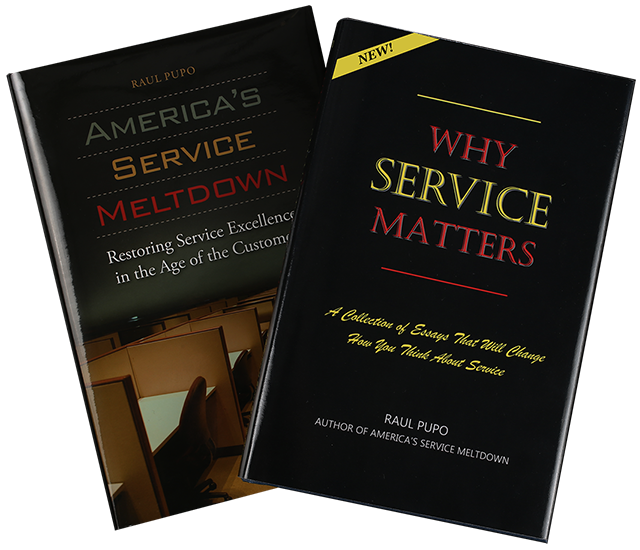
AMERICA’S SERVICE MELTDOWN: RESTORING SERVICE EXCELLENCE IN THE AGE OF THE CUSTOMER


A close up of the words american service meltdown

Raul’s award winning book

Raul talks about America’s Service Meltdown with marketing guru Barry Epstein.


http://www.youtube.com/watch?v=h3f0oa6yYt8

Share

CUSTOMER SERVICE: RAUL SPEAKS AT DISTINGUISHED LECTURE SERIES


A man with white hair and wearing a suit.

Raul’s award winning book

See Raul Speak at NOVA Southeastern University’s Distinguished Lecture Series


http://www.youtube.com/watch?v=gHyeeGqER40&list=UU9dLLKicNnxKdhFFxNGmH6w&index=1

Share