Editor's Picks

“THE ENEMY OF MY ENEMY IS MY FRIEND”

All in all, this is a wise proverb. President Trump’s decision to stay out of the Turkish-Kurdish fray unless our geopolitical interests are threatened is a wise decision.

Turkey’s incursion into Northern Syria in pursuit of Kurdish rebels has been almost universally deplored by the media and politicians in both the United States and Europe. The outrage is justified but it is curious that no such outrage has heretofore been voiced as the Turks have been bad actors for a very long time. Examples abound as Turkey has a long history of execrable misbehavior in their part of the world directed especially at Christians. Turkey’s genocidal campaign which began approximately one hundred years ago gathered additional steam with the Istanbul pogrom of 1955 which left many dead and private property in ruins. Such ethnic cleansing did not subside until well into the nineteen nineties during which time Greeks on the islands of Tenedos and especially Imbros were persecuted and purged.

Turkish aggression against the Greeks currently takes the form of frequent violations of Greek airspace by fighter aircraft, and an intensified naval presence stretching from the Greek island of Rhodes – fewer than twenty miles distant from Turkey as the crow flies – to the island nation of Cyprus. Turkish seismic research vessels now operating within Cyprus’ territorial waters have practically encircled the island. In the light of recently discovered hydrocarbon deposits in the areaTurkey has stated that it is ready to begin gas exploration. Turkish Foreign Minister, Mevlut Cavusoglu, warns that not even a bird will be allowed to fly over the Aegean without Turkey’s permission.

Turkey’s belligerence in the area has been on display before. In 1974 Turkey invaded and occupied about one-third of Cyprus and NATO proved powerless to stop it. The do-nothing diplomatic corps, of course, claimed that “legally” their hands were tied because Cyprus was not a member of NATO. To this day, it remains obvious that Turkey has territorial ambitions that include not only Cyprus but the Greek islands in the Eastern Mediterranean. 

Devlet Bahceli, leader of the Turkish nationalist party (MHP),  is clear when he says that “… Cyprus is Turkish. It’s a Turkish homeland and it will remain Turkish. The will for the Aegean to again become a grave for Greek aspiration is still alive.” Mr. Bahceli’schurlish remarkis an obvious reference to the savagery that was unleashed on the Greek community in the Eastern Aegean city of Smyrna, in Asia Minor, in 1922 when Turkish troops and their allies razed the historically Greek city to the ground.

THROW THE KURDS A LIFELINE?

It is now conventional wisdom that the United States has abandoned its allies, the Kurds, in their struggle against Turkish aggression. But the United Sates and the West need to think twice before throwing the Kurds a lifeline as they have a checkered legacy: 1) Beginning in 1894 and continuing through the nineteen-twenties the Kurds did a lot of the dirty work for the Turks in the massacre, rape, pillage, and plunder of Christian Armenians, Greeks, and Assyrians. The death toll from the thirty-year long atrocities numbered approximately two million innocents. 2) Winston Churchill’s ill-fated and admittedly hare-brained scheme to invade the Gallipoli peninsula in 1915 was met by the stiff resistance not only of Turkish soldiers but also of Kurds and Arabs who inflicted heavy losses on ANZAC troops. 3) The Kurds did not fight on the side of the Allies during WW II. Anti-Trump talking heads claim that it was not possible for the Kurds to assist the Allies as they did not have a state. Being devoid of a state, however, did not keep the Kurds from participating in the Christian genocide at the turn of the previous century. 4) Kurdish insurgents have indiscriminately killed many police, military personnel, and civilians, both Turkish and foreign in Istanbul, Ankara and other cities as they continue to press their case for an independent Kurdistan which would spill beyond Turkey and onto Syria, Iran, and Iraq. Turkey’s fear that the Syrian Kurdish rebels might make common cause with Kurdish terrorist groups operating inside Turkey’s borders is hardly irrational. 5) Religious extremism is still the norm particularly in rural Kurdish-controlled areas. Female genital mutilation, honor killings, and child marriages are not uncommon to this day.

Share

THE SERVICE ETHIC: THE ULTIMATE GUARANTOR AGAINST MORAL HAZARDS

It is commonplace that individuals and the companies they represent over-commit, over-sell, and over-promise in an effort to make a sale, and in a broader context to steal a march on the competition. And, while self-interest shall remain forevermore the primary motive of human behavior, acting on ethical principles has been demonstrated to be good for the individual and therefore in the best interests of the organization.

When behavior to misrepresent a customer is acted out knowingly it creates a moral hazard that an executive leadership group driven by an ethical construct that goes beyond a fixation with the bottom line can not countenance and must move to stop dead in its tracks. A moral hazard arises, therefore, when a party to a transaction acts in bad faith knowing full well that the risk of such an action is borne by another party. A moral hazard taken to an extreme can lead to criminal behavior.

A MORAL HAZARD LIKE NO OTHER

I wrote about what perhaps was the most egregious ethical failure ever visited on the largest number of consumers when I discussed the subprime mortgage fiasco in America’s Service Meltdown. I’ll quote directly from the book. “The subprime mortgage crisis which began in 2007, racked up roughly $200 billion in defaulted mortgages. The crisis also violently convulsed the credit markets. Fannie Mae and Freddie Mac, government sponsored enterprises chartered to provide a stable supply of mortgage money for home buyers, sucked in $200 billion in order to remain solvent. The consequences of the crisis were so widespread that it could not spare many of the presumed titans of Wall Street: Bear Stearns, one of the largest underwriters of mortgage bonds, was bought by JP Morgan Chase for approximately seven cents on the dollar. Washington Mutual, the nation’s largest savings and loan, was also bought by JP Morgan Chase, for approximately three cents on the dollar from its price a year before. Merrill Lynch was bought by Bank America in a shotgun wedding over a weekend (facilitated by much strong-arming by the federal government, the deal was approved by shareholders who were falsely told that Merrill Lynch executive bonuses of as much as $5.8 billion would not be paid without the bank’s consent when in fact the bonuses had already been authorized). AIG, the largest insurance carrier in the nation with much of its portfolio in mortgage-related products, and a casino operation that hedged exotic debt instruments, had to be bailed out with a $180 billion loan by the federal government (ultimately repaid by AIG including a $23 billion profit to taxpayers). And, Lehman Brothers, one of the most exposed banks to the subprime mortgage market, went out of business after 160 years.”

Moral hazards were on display during the subprime mortgage debacle courtesy not just of greedy financial institutions but of others as well: Home buyers lied about their incomes and lived beyond their means; mortgage brokers were incented to sell high-risk mortgages and did so with abandon;  mortgage underwriters processed applications without full documentation so as to score big production numbers; regulators lowered capital lending requirements, and overrode anti-predatory state laws; credit rating agencies rated mortgage-backed junk as AAA securities, and so forth.  The real estate bubble, fueled by artificially low interest rates, gave all the players a “high” who became giddy with their own success. Whatever the attribution of the crisis is assumed to be, however, in the end it was a failure to serve the consuming public.

Similarly, Rick Singer, the fraudster behind the college admissions cheating scandal, which culminated in the indictment of over fifty people, was hardly alone in his role depriving hard-working and honest students of a chance to be legitimately accepted to college. Test administrators, athletic department staff, coaches, and parents were all complicit in what federal investigators say was the largest college admissions scandal ever generating millions of dollars for the scoundrel Singer.

There is always the potential to give rise to a moral hazard anytime one party to a transaction has an incentive to behave against the interests of another party. Moral hazards can be mitigated somewhat by regulations but, in the end, regulation spells out the lowest common denominator of acceptable behavior. And, besides, regulations do not provide enough of a deterrent to keep crooked individuals on the straight and narrow. Consider that only one Wall Street banker went to jail for fraud (although lesser luminaries did end up in the slammer and some are still behind bars). In most recorded cases of fraud and abuse, it’s important to remember, there were laws on the books to preclude the offensive behavior.

Moral hazards can also be mitigated by the presence of contracts that are fair and balanced and which give as much as they take. Unfortunately, the preponderance of marketplace transactions is essentially one-way and invariably favors the supplier. I had a client that commissioned a third-party software contractor to build an e-commerce portal. Unfortunately, the contract was written in such an abstruse and recondite way that not even my client’s legal counsel picked up on the fact that the contractor was not writing the software code as a “work for hire.” Which is to say that my client, for practical purposes, had no ownership rights to the software. It wasn’t until my client had spent serious sums of money developing the portal that my team discovered the contractor’s sleight-of-hand. In the end, my client had to litigate the matter and incur significant legal costs. Finally, the admonition to the consumer of caveat emptor is helpful but hardly practicable in the rapid-fire of day-to-day commercial transactions.

THE SERVICE ETHIC: AN OBVIOUS SUPPLIER OBLIGATION

The acts of fraud and abuse perpetrated by corporations and others are the result of individuals operating in an ethical vacuum. All of the regulations in the world, therefore, will not prevent fraud. Remember, there were plenty of regulations in place at the time of Bernard Madoff’s fraudulent scheme. Similarly, there were regulations in place at the time of Enron’s fraud. In that case, CFO Andrew Fastow chose to break the rules with his financial shell game. And, Elon Musk, CEO of Tesla Inc. knowingly flouted the SEC’s financial disclosure regulations for his own aggrandizement.

The consequences of ethical misconduct are real and severe and will, in time, doom the mightiest enterprise. Adelphia Communications, Arthur Andersen, Tyco, Qwest, Wachovia, and WorldCom are but a few of the names which were eventually cut down to size for their continued arrogance in the face of flagrant moral, and ultimately illegal, misbehavior. Unfortunately, the comeuppance suffered by these malefactors is little consolation to those individuals who lost their jobs, their homes, and their hard-earned life-savings at the hands of these unscrupulous predators.

Still, the depredations continue. As one contemptible example, Wells Fargo was ordered to pay $185 million in fines and penalties for opening unauthorized deposit and credit card accounts. More recently, the bank was slapped with a civil penalty of $1 billion by the Consumer Financial Protection Bureau (CFPB) for mortgage interest rate fraud and for forcing nearly two million customers to buy unnecessary auto insurance. Wells Fargo seems to revel in a culture of deceit and appears hard-wired to cheat. Since 2000, according to Violation Tracker, a search engine focused on corporate misconduct, Wells Fargo has been fined nearly $11.5 billion for sixty-one different abuses. This, from a “too big to fail” bank that cost taxpayers $36 billion in bailout funds. Clearly, Wells Fargo has never been too big to cheat.

Another example of ethical misconduct involves Facebook. The company’s default privacy settings and use of personal data have been found to be illegal by a German court. It is estimated that over 50 million user names were sold by Facebook to various providers. Legalities aside – Germany has very strict privacy prohibitions compared to the United States – what is disgustingly unethical on the part of Facebook is that the fine print of its Terms and Conditions was purposely recondite to allow the company to “infer” the user’s permission to share private data. But what is most unconscionable is that Facebook’s Founder and CEO, Mark Zuckerberg, on numerous occasions has publicly stated that the company “will never sell your information without consent.” Mr. Zuckerberg’s execrable behavior, in effect, gives a green light to others in the organization to lie and cheat as the boss would have it.

Not to be left behind is Uber’s cover-up of a hacker’s breach which amounted to the theft of the personal information of approximately 25 million customers and drivers. Instead of reporting the breach to authorities, which is required by law, Uber chose to keep the matter hush and pay the hackers a ransom thereby risking additional fraud and theft. In the end, the subterfuge cost the company a settlement of $148 million. Incidentally, Uber’s misconduct in that case followed on the heels of the Federal Trade Commission’s (FTC) $20 million settlement with the company for making misleading income and lease agreement claims to its drivers. So much for ethical leadership.

The onus to treat the consumer fairly rests squarely with the supplier. That is obvious and true if at times rarely practiced. But that obligation is underscored if the organization abides a service ethic. The Service Ethic, as I have formulated it, are those principles and practices that govern how individuals and their organizations behave toward the customer. The Service Ethic rests on three pillars:

1. Craft a mission to serve the customer. Articulating a mission is a most important first step in focusing the organization’s principles and practices. The mission must be clear, unambiguous, and succinct in stating that “customers are first.” I have used that opening salvo in the mission statement of all of my companies so as to leave no doubt what we valued most dearly. And, as confusion reigns supreme in many circles about what constitutes a mission statement versus a vision statement the following distinction is my take on the difference: a mission statement is how you want to run the company; a vision statement is an expression of reach which lies beyond the company’s current grasp. A statement that expresses the company’s desire to garner, say, 20% of the market is a prototypical example of a vision statement.

Commitments to employees, stockholders, and other stakeholders although clearly important in their own right cannot purport to represent the raison d’être of the corporationTo serve the customer and the marketplace is the principal reason for the corporation to exist and it must trump all other considerations.

2. Reinforce the mission operationally. Service-leadership responsibilities must be consistent with the mission while being grounded at the operating level. By way of examples, the leadership must follow through on the following: 1) hire service-smart workers, 2) empower workers to act in the customer’s behalf, 3) provide workers with a program of continuing education geared to new product and service offerings, 4) support workers with information systems geared to interact with customers effectively and efficiently, 5) incent service workers with the appropriate tangible and intangible rewards, 6) ensure public and private messaging does not subvert the mission, 7) take remedial action with intransigent workers, and 8) allow whistleblowers the freedom and protection to sound the alarm when something seems untoward.

3. Abide the Golden Rule of Service: A worker’s correct ethical choices should be grounded on the following two propositions, neither of which can be implied to bring harm to others: 1) “Do what you say you are going to do”, and 2) “Don’t do what you say you are not going to do”. And, yet this simple formula is systematically flouted by most organizations. Adherence to these propositions – admittedly, more easily said than done – speaks tomes to the character of the individual and his organization. A failure to abide by these propositions while making excuses or lying about why a stated promise wasn’t kept gradually erodes the goodwill that has been built with the customer or keeps customer goodwill from being established in the first place. Moreover, being faithful to a promise or commitment made to a customer isn’t just good business – which obviously it is – but it is virtuous behavior which should comfort the responsible individual.

It is gaining more and more currency that consumers focus as much on the integrity of their suppliers as on the quality or price of their products. It is a visionary executive leadership group, moreover, that understands that service excellence driven by an unremitting adherence to the Service Ethic can prove an unassailable competitive advantage in the twenty-first century while enhancing the moral standing of the corporation. The reach of the Service Ethic extends far beyond mere legalities. As the great German philosopher Immanuel Kant said, “In law, a man is guilty when he violates the rights of others. In ethics, he is guilty if he only thinks of doing so.”  

Share

GLOBALIZATION: AN ANTI-DEMOCRATIC NIGHTMARE IN THE MAKING

Editor’s note: The current demagoguery in the hands of globalists takes the ugly form that a citizen who believes in national borders and national priorities cannot be a good citizen – that he is a fascist some claim. We need to be reminded that the American revolution was a nationalist uprising which few would call fascist. The current sophistry in the hands of globalists belies that a citizen who is devoted to his homeland and who places the interests of his nation-state as the top priority can exist, at the same time, with a world view that is tolerant and respectful of those beyond his borders. Furthermore, to be respectful of global interests is not to suggest that those that can afford it should be forced to open their pocketbooks to fix all of the world’s ills. That suggestion is impudent and a sleight-of-hand by globalists whose own personal agendas for control stand to be upended by the rights and privileges of sovereign states. Simply stated, globalism is imperialism in sheep’s clothing. What other conclusion is there to be had when an international organization made up of unelected bureaucrats imposes its will on the citizens of member nations? That supranational organizations are anti-democratic is a statement of fact and not of ideology.

Globalists purposely conflate political globalization with its clear and direct threat to the sovereignty of nations with economic globalization which, in the main, works best when allowed to function in accordance with free-market forces. The reason for the masquerade is clear: globalists reckon that political globalization has an increased chance of coming to pass if global trade is so inextricably woven that only the supranational organization can referee its smooth sailing.

Supporters of globalization argue that the world is facing a historical inevitability: a stage that all nations must experience as they are swept away by the inexorable forces of modernity. This so-called inevitability theory is a slick rhetorical attempt to stifle debate before it has begun in earnest not in elite circles, where it is fashionable to abide the theology of globalization, but in town halls, factory floors, and chambers of congress.

Trade globalization or economic globalization has a historical cyclicality that dispels its presumed inevitability. Beginning in the middle to the late nineteenth century there have been significant oscillations in world trade using total exports as a percentage of world GDP as a barometer. To underscore this cyclicality, one has only to look at the level of trade that was conducted as the nineteenth century drew to a close to realize that such a level of trade was not seen again until the late nineteen sixties.

Globalization gets a lot of oxygen from proponents of free trade because a concept which implies freedom must obviously represent goodness for all of humankind. America’s historical experience with economic globalization, however, is decidedly different as the nation has racked up an accumulated trade deficit of approximately $10 trillion during the last four decades. Tragically, millions of workers have lost their jobs during that time, in effect, financing the trade deficit while one administration after another in Washington turned the other cheek to our trading partners who excelled at cheating through currency manipulation, intellectual property theft, import tariffs, dumping of commodities at less than cost, and prohibited commercial activities.

The current clamor which accompanied President Trump’s imposition of import tariffs on certain goods and commodities as presaging a “trade war” is disingenuous if a thinly veiled political bias against the President. To the best of my knowledge, there was no such uproar as the nation was being pummeled by one-way trade deals by friends and foes alike for decades. In effect, we have long been in a trade war albeit with one hand tied behind our backs. The trade imbalance with China is especially appalling. Of the $10 trillion trade deficit the United States has racked up, better than 50% or $5.2 trillion comes courtesy of China. That translates into a trade imbalance in goods and services of $400 billion to $500 billion a year. And, for those who argue that import tariffs are, in effect, a tax on U.S. citizens they need to sharpen their pencils. The millions of jobs lost, the depression of wages, the thousands of factory closures, the contraction of R&D, and the export of capital due to the nation’s trade imbalance has saddled citizens with a tax that makes the effect of import tariffs miniscule by comparison.

Cheerleaders for “free trade” need to be reminded that Japan would not be where it is today, sporting its global manufacturing prowess, if it had not booted American automobile manufacturers out of the country in 1939 – ostensibly for reasons of national security – so that the government could protect and finance its fledging auto industry.

According to economist Ha-Joon Chang in his book, Bad Samaritans: The Myth of Free Trade and The Secret History of Capitalism, “…had the Japanese government followed the free-trade economists back in the 1960’s, there would have been no Lexus automobile.” Toyota Corporation as well, added Mr. Chang, might have been wiped out had it followed the free traders’ advice. Automobile import prohibitions remained in place in Japan until October, 1965. Clearly, Japan was more interested in protecting its automobile industry than in practicing “free trade.”

As far as the United States is concerned, the principal bad Samaritan on the world stage is China. It is estimated that China purloins roughly $225 billion, at the low end and as much as $600 billion at the high end, annually in counterfeit goods, pirated software, and theft of trade secrets from the United States.  In a feeble attempt to justify their misbehavior, the China Ministry of Commerce alleges that China is still a “developing” country.

Adding to China’s protectionism is a list of hundreds of products which are banned from importation including stethoscopes, refrigerators, digital cameras, video games, and television sets. And, it isn’t just products that are proscribed. On the internet front, China has built yet another Great Wall to keep companies such as Facebook, Google, Twitter, and YouTube from operating in the country. This Wall doesn’t just aid and abet China’s censors but it limits foreign competition so that homegrown companies like Baidu, Alibaba, and Tencent can thrive in monopolistic markets. Again, so much for free trade.

WHO IS ACCOUNTABLE TO WHOM?

The globalization conceit held by world leaders in and out of government should sound an alarm to those who believe in the sanctity of democratic processes. Put simply, globalization and democracy are hardly fraternal twins. Globalists believe that globalization’s ugly side, lower wages, lost jobs, shuttered factories or devastated communities is the result of there not being enough global governance to channel all of the good that derives from globalization. And besides, globalists say, any discomfort is strictly temporary. As Mr. Pascal Lamy, former Director of the World Trade Organization (WTO) said in a recent address, “The future lies with more globalization, not less…”

The hubris of a technocrat like Mr. Lamy is lamentable but it must be rebuffed. The French – who do not want to be “out-globalized” by the Germans – are talking about bringing Europe closer “together” by harmonizing fiscal policies, setting a minimum wage in every country, and by establishing a European Union (EU) zone budget run by a finance czar.

Globalization undermines local and national boundaries thus ceding political sway to the unelected officials of supranational organizations such as the WTO, the International Monetary Fund (IMF), the United Nations, and the EU. And, make no mistake about the fact that globalists know perfectly well that to achieve their coveted “Global Neighborhood” they need to first achieve a global economy.

It is clear that no political actor is further removed from serving citizen voters – the legions of coal miners, fishermen, tobacco growers, and grape pickers – than the self-dealing bureaucrat whose loyalty, first and foremost, is to a soulless supranational organization. Yet it is the citizen voter who by the sweat of his brow finances the mammoth spending budgets of supranational institutions. The European Parliament is notable for its excesses as it operates out of three separate locations: Brussels, Luxembourg, and Strasbourg, France. Each month over 750 MEP’s – Members of the European Parliament – travel between Brussels and Strasbourg while schlepping their banker’s boxes full of documents at a cost to taxpayers of over $100 million a year. Incidentally, for all of the sermonizing by the French government against nationalist/populist movements across the continent and the United States, what are the chances that the French would agree to shut down the Strasbourg parliament location in the interest of fiscal prudence and global harmony? As a further slap to the face of the citizen voters of Europe much of the lawmaking by Parliament is done clandestinely: to speed up the process the parliamentarians protest!

According to recent statistics, the European Union budget is roughly a gargantuan $173 billion – of that total, the EU states, 6%, or $10 billion is spent for administrative purposes; The World Bank’s spending budget comes in at $4 billion; the IMF’s, a miserly $1 billion. The scale of these numbers is understandable when one considers that the headcount at the European Union is roughly 50,000, at the World Bank 10,000, and at the IMF nearly 3,000.

Many of these bureaucrats are hardly selfless civil servants as corruption runs rampant across many of these institutions. The Oil-for-Food Program of the United Nations, the inception of which was overseen by U.N. Secretary General Boutros Boutros-Ghali, lost nearly $2 billion to corruption. In the end, not even the Secretary General nor his family members could escape culpability from the scandal. At the World Bank, somehow $2 billion in cash was misplaced – a computer glitch the Bank alleges. But that is peanuts compared to the $100 billion that Northwestern University Professor Jeffrey Winters’ research shows was squandered by the Bank – directly or indirectly – over time due to corruption. And, according to Professor Winters only about seventy cents of every dollar of loan funds makes its way to the destitute and poor who need the aid the most.

Exorbitant costs, bloated bureaucracies, corruption, secret balloting, and no accountability to a sovereign nation: welcome to globalization. And it isn’t just the bureaucrats with their hands in the till as ambassadors, heads of state, diplomats, and others are deeply enmeshed in supranational negotiations and decision making.

President Trump’s opposition to the funding shenanigans of supranational organizations – Mr. Trump took special aim at the U.N. and NATO – and by extension his animus toward unfair trade deals such as the Trans Pacific Partnership (TPP), the Paris Climate Accord, and the North American Free Trade Agreement (NAFTA) had globalists in a catatonic state because they feared the loss of the historical obsequiousness of the world’s leading provider. When Joe Biden became President these organizations all breathed a sigh of relief.

GLOBALIZATION AT WORK: THE GREEK EXPERIENCE

The EU represents the most aggressive attempt to integrate sovereign states into a supranational body. The original visionaries of the European Union, World War II German militarists, academics, and industrialists, were determined to prolong the Reich albeit in an economic incarnation. In this, they were supremely successful as they found a way to win the peace albeit having lost the war. New wealth and markets were indeed found for German products but at the expense of the livelihoods of millions of European citizens in less developed areas of the continent.

Greece stands out as a tragic example of a nation that has gotten sideways with the totalitarian practices of the European Union. As a member state of the Eurozone – one of nineteen European countries trading in the Euro currency – Greece has been humiliated for running afoul of the European Union’s dictates. In the aftermath of the financial meltdown of 2008 non-market solutions were brought to bear to deal with the crisis. The Troika of supranational organizations – the European Central Bank, the IMF, and the World Bank – forced severe, if not punitive, structural reforms on Greece which have proved counterproductive and which almost guarantee that the nation will never be able to repay its debt of approximately $400 billion. In ironic contrast, as I point out in a separate essay, Germany Has Welched on its Moral Obligations Before, the Greek Deputy Minister of Foreign Affairs, Mr. Dimitris Mardas, has calculated that Greece is owed about $305 billion in World War II reparations by the Germans.

The Troika’s measures have clearly compromised the nation’s sovereignty. What is worse, the Troika’s restrictive measures have straight-jacketed the nation’s ability to grow its GDP making it forevermore subservient to the whims of bureaucrats of the European Union. The Troika compelled Greece to implement suffocating capital controls which hampered local investment; adopt austerity programs that have hit every pensioner and worker; and institute budget cutbacks in infrastructure, technology, education, and job training. Austerity has hit higher education and healthcare especially hard. Greece’s university system – free to all who qualify – is severely underfunded and understaffed forcing many departments to close. Healthcare spending has been cut by one-third since the onset of the financial meltdown with millions of citizens devoid of healthcare benefits. As a protest placard brandished before the ministry of health by hospital technicians in Athens poignantly stated “the ministry has moved to Brussels.”

I have witnessed the upshot of many of these “reforms.” Many citizens now eat only sparingly and survive the winter months without heat. Others live with extended families under one roof as a way to share the financial burden. Hospital patients are oftentimes forced to sleep in hallways, many times in beds that have not been disinfected, and to rely on friends and family to supply clean linen and blankets – some hospital rooms can go weeks without hospital staff changing a patient’s bed linen. Hospital rooms have no bedside telephones – never mind television monitors to deliver to patients a source of diversion and entertainment – and no air conditioning. Windows left open to provide a modicum of ventilation let in swarms of insects instead. Of course, families able to afford the expense still rely on the Greek tradition of fakelaki – the little envelope stuffed with bribe money meant to expedite proper care for their loved ones. But money cannot help the infirm and injured be succored as oftentimes ambulances are not available or they arrive too late.

It is no surprise that the population of Greece has declined by close to 5% since the onset of the financial meltdown and will continue to shrink in size. Most worrisome, is that the bulk of those who have chosen to emigrate are young professionals leaving the nation devoid of brainpower. Many who do remain do so because they are trapped by family or other circumstance: a civil engineering graduate who tends bar, a teacher who waits tables, an archaeologist who works at a bakery, among many, many others. In the end, Greece is likely to become not much more than a nation of pensioners and tourists.

SOVEREIGN NATIONS IN THE HANDS OF GLOBALISTS

The Greek experience transpired, in large measure, against the backdrop of a succession of socialist government regimes which lived beyond their means by, among other things, making pension and benefits promises to its citizens which were financially unsustainable if ballot box proof. It’s instructive to remember that Prime Minister of Greece, George Papandreou, a third generation Papandreou who became Prime Minister, like his father and grandfather before him, asserted not many years ago that “…we are observing the birth of global governance, and that …”we must be committed to carrying this out.”

Papandreou’s socialist conceit was further underscored after Marxist-Socialist Prime Minister Alexis Tsipras came to power. The self-avowed globalist who got elected on an anti-austerity platform, soon thereafter submitted before the Troika’s confiscatory demands and subsequently became a paragon for austerity that choked the nation.

If the Eurozone has been an unmitigated disaster for a poor nation like Greece how has the most muscular economy in Europe fared? It seems, not as advertised. The German economy has grown at an anemic average of .8% for the last decade. And, when looked at from the point of view of GDP growth per capita of working age, the non-Eurozone countries of Sweden, Switzerland, the United Kingdom, and Norway have outperformed their Eurozone counterparts by a factor of close to seven times. Still, Germany, for all practical purposes, is the European Union. And, the European Union is, practically speaking, a Fourth German Reich.

This state of affairs was presaged by the former Prime Minister of the United Kingdom, Margaret Thatcher, in her 1992 speech at The Hague, the Netherlands, when she said that “Germany’s preponderance within the [European] Community is such that no major decision can really be taken against German wishes. In these circumstances, the Community augments German power rather than containing it.” All you have to do is ask Poland, Germany’s neighbor to the east. Germany virtually controls all media expressions in Poland including Internet portals, radio, television, newspapers, and magazines. Now comes the EU’s meddling and disenfranchising threat if Poland follows through on the sovereign nation’s judicial reform. If that weren’t enough Martin Schulz, the leader of Germany’s Social Democratic Party (SPD), has called for a “constitutional” convention to draft plans for a “United States of Europe” by the year 2025. Countries that fail to ratify the agreement, Mr. Schulz avers, would be forced to leave the Union.

GLOBALIZATION’S END GAME

In 1995, the Commission on Global Governance penned a lengthy report entitled Our Global Neighborhood. The work had the full support of the aforementioned Mr. Boutros Boutros-Ghali and was financed in part by groups such as the Carnegie Foundation and the Ford Foundation. Read the full Commission report to gain an appreciation for the disdain these globalists have for the sovereign nation-state. But to whet the appetite of the present reader the report calls for, among other things, a global tax system, a standing U.N. Army, an Economic Security Council, and an expanded role for the Secretary General. Now comes the latest assault on the sovereignty of nations by an IMF proposal to create a slush-fund of $650 billion denominated by a super-currency dubbed Special Drawing Rights (SDR’s) to be spent by global technocrats on pet projects as they see fit. It remains to be seen what the effect on the U.S. dollar’s status as the world’s reserve currency will be but the threat is clear.

Commission member and former Under Secretary General of the United Nations, Maurice Strong, made clear his stance on globalism when he stated that “It is simply not feasible for sovereignty to be exercised unilaterally by individual nation-states…” This is the same Mr. Strong that left his U.N. post after investigators found he had received a near one-million-dollar check from a South Korean business man who was convicted in a U.S. Federal court for conspiring to bribe U.N. officials in the Oil-for-Food Program.

As the world moves through ever-quickening stages of globalization, with potentially conflicting value systems among individuals and nations, the stage is set for more and more complex dilemmas to emerge. The indigenization being experienced across cultures around the world, especially in Muslim countries, is a clear retort to the unwelcome entreaties of a more interconnected and globalized world. As Professor Samuel P. Huntington states in his provocative book, The Clash of Civilizations, “Little or no evidence exists to support the assumption that the emergence of pervasive global communications is producing a convergence in attitudes and beliefs.” The opposite might be closer to the truth: a more globalized world might become a more conflicted world.

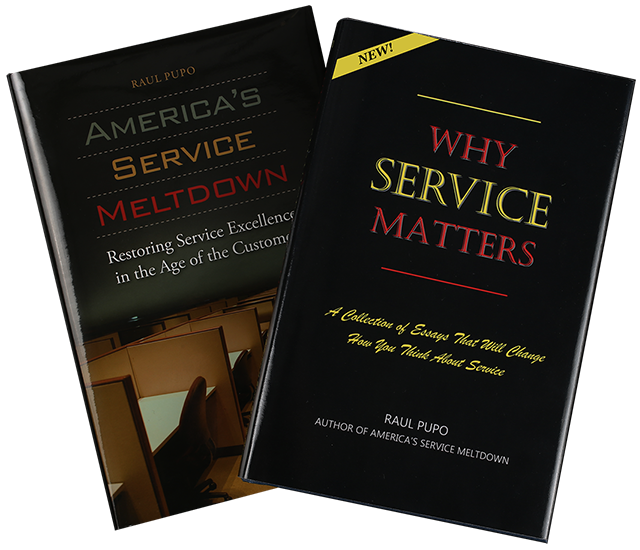
Share

CUSTOMER SERVICE CLAIMS AS RHETORICAL SPIN

What can I believe? This is a familiar lamentation by consumers when confronted by the product and service claims made by firms of every size and stripe in the marketplace. Nearly sixty years ago, historian Carl Becker in his book, Freedom and Responsibility in the American Way of Life, madethe following claim: “No one can deny that much of our modern advertising is essentially dishonest…” Becker also saw the tension between freedom of speech and freedom of lyingand believed that corporations should have the latter freedomcurbed. Apparently, not much has changed in this regard since Becker’s time.

Comcast Corporation’s slogan, for example, that “Technology and innovation have always been at the heart of what we do” is a less than artful rhetorical spin since the conclusion is obviously embedded in the marketing claim. How many consumers are taken by the slogan is hard to tell but the company seems to double down when making a commitment to its customers that it will: 1.”respect your time, 2. simplify your experience, and 3. make things right if we fall short.” If the slogan is inartful, the “commitment” is gibberish and obviously counterfactual. Again, what impact this has on the consuming public is hard to tell.

What is not hard to tell is that in J.D. Power’s rating of major wireline services, the company received the worst scores in cost to consumer, performance, billing, and reliability. It is little wonder that the Federal Communications Commission has seen fit to fine Comcast $2.3 million over allegations the company charged customers for services they never received. Yet, Comcast remains the number one provider in total broadband connections with over 24 million subscribers in the United States. And, as larger and larger swaths of the country become cable monopolies – in my area, the non-Comcast provider’s maximum available download speed is nowhere near the FCC mandated broadband standard of 25Mbps – there may be reasons to forgive the company for its amateurish marketing messaging.

RHETORIC HELPS TO VEIL FALSE CLAIMS

Aristotle teaches that rhetoric as a form of persuasion relies on three basic appeals: 1) ethos, persuasion based on the character or celebrity of the speaker delivering the message, 2) logos, or persuasion based on logic and facts, and 3) pathos, a reliance on emotional or humorous stirrings.

We are predisposed to believe a message when it is delivered by a known, credible, or celebrity figure. This is especially true if the facts surrounding an issue in question are unclear. Still, it is axiomatic that the rhetor – the   speaker presenting the claim – has a clear path of authority on the subject.

William Devane, the star of stage, television, and Hollywood films is an engaging pitchman for Rosland Capital, a company which trades in gold and other precious metals. Mr. Devane carries himself well and projects a likeable persona in his commercials for Rosland. Mr. Devane suggests in a commercial dripping with pathos – the Battleship USS Iowa’s menacing 16-inch guns are in the background – that “there are forces everywhere pulling our country apart, threatening our economy and our way of life.” Mr. Devane’s solution? Buy gold.

To the best of my knowledge, Mr. Devane is not a precious metals investment guru. If he is, he doesn’t say so in the Rosland commercials. Further, his pop-culture celebrity can hardly obscure the facts. Gold, it turns out, has been a ho-hum investment. In the period 1986 to 2016 the annual rate of return of gold, with inflation factored in, is an unimpressive 1.3% per year. More perplexing, is the choice of an octogenarian to pitch gold. Presumably, Rosland is aiming at an older demographic with Mr. Devane as its spokesman. Given gold’s snail’s paced growth over the last thirty years, however, the metal seems hardly a worthy investment for a senior citizen. This and other Rosland commercials fail to carry their claims based on an appeal to facts and logic.

In my experience, the vast number of public utterances, declarations, and slogans coming from companies both large and small on the subject of customer service – if not all claims having to do with a product’s presumed prowess – is rarely rooted in fact. Little has changed since 1957 when Vance Packard wrote the immensely popular book, The Hidden Persuaders. In that book, Packard stated that we rarely buy products and services based on logos – that is, the intrinsic qualities of a product or serviceRather, that we fall prey to appeals that play to our emotions.

JetBlue Airways’ Customer Bill of Rights states that the company “… is dedicated to inspiring humanity.” The company further states in its financial report that, “One of our competitive strengths is a service-oriented culture grounded in our five key values: safety, caring, integrity, passion, and fun.” The company’s grandiloquence aside, this is the same airline that kicked a couple, accompanied by a small medical alert dog, off a flight because the passenger’s doctor’s notice – dutifully signed, on letterhead, and with the physician’s contact information – was not typewritten! Now, that kind of service behavior is sure to inspire humanity.

“EXCELLENT CUSTOMER SERVICE IS OUR HALLMARK”

Wachovia Bank, once one of the largest banks in the nation, publicly, and with great fanfare, announced that it had made an investment of $100 Million to upgrade frontline staff to better serve its customer base. Crowing about the recently released American Customer Satisfaction Index (ACSI), which showed Wachovia was ranked the number one bank for customer satisfaction, its chairman and CEO, G. Kennedy Thompson, had this to say: “Providing excellent customer service is a hallmark of our company, and this award is a testament to our success.”

Meanwhile, the bank was processing unauthorized, unsigned check transactions from thousands of accounts; representing auction-rate securities – complex, illiquid debt instruments – as alternatives to liquid money-market funds; ignoring anti-money laundering federal guidelines; and selling negative amortization mortgages whose principal balance would increase if the customer chose the lowest payment option available. In the first instance, court documents show that bank executives knew of the fraudulent scheme that allowed telemarketers to steal hundreds of millions of dollars from unwary depositors but failed to stop it. The reason: telemarketers were a huge source of revenue for the bank. As to the bank’s sales practices of auction-rate securities and negative amortization mortgages, and its disregard for money laundering safeguards it is clear the intent was to deceive the consuming public while feathering its own nest. So much for “customer service as a hallmark.”

Wachovia’s experience is proof positive that clichés and slogans alone won’t cut it. In April 2008, Wachovia agreed to pay $144 Million to settle claims that it allowed telemarketers to bilk depositors. In June 2008, Mr. Thompson was ousted. In July 2008, the bank eliminated 11,000 jobs. In August 2008, regulators forced the bank to buy back $9 billion of auction-rate debt, pay a $50 Million fine, and make no-interest loans to consumers hurt by the fraud. In October 2008, the bank a victim of the subprime mortgage implosion it had a huge hand in inducing, got its comeuppance for its systemic cheating as it was picked over by both Citigroup and Wells Fargo. In the end, Wells Fargo – a prodigiously unethical financial institution – prevailed by offering $11.7 billion for a bank that was worth ten times that amount only one year earlier.

Oh, and what about Wachovia’s number one ranking for customer satisfaction in the ACSI survey? It turns out that on this occasion the ACSI survey only covered five banks – this, out of a bank population of roughly 7,000 banks in the United States at the time of the survey. Most egregiously, however, the bank’s mortgage, investment, and brokerage customers – the source of many of the bank’s major transgressions, aside from money laundering and unsigned check fraud – were not included in the ACSI survey. So much for a number one ranking!

Wachovia’s profound disregard for the customer is perhaps epic but lest consumers think this is a one-off episode consider that every claim from the niggling – Blockbuster’s “no late fees” acclamation which proved to be false – to the tragic – Bernard Madoff’s “I made a lot of money for my clients” when, in fact, he was running a scheme Charles Ponzi would have been proud of – Ponzi apparently swindled clients out of $7 million when he was finally apprehended in 1920 and which even in today’s dollars would amount to a pittance compared to what Mr. Madoff swindled from his clients. Tragically, multiple investors struck with the horror of their losses took their own lives, including Mr. Madoff’s son Mark. In the end, the onus rests on the consumer to reach for the logic and facts of a supplier’s service claims.

Share

SUPERIOR CUSTOMER SERVICE: TURKEY SHOULD HOPE IT WERE THE SOLE ADMISSION STANDARD TO THE EUROPEAN UNION

Editor’s note: A couple of summers ago my wife and I had occasion to spend a week in Istanbul, Turkey. The city is clean, bustling, and thriving. Construction cranes can be seen on the horizon in every direction. And there is more to come. Mega projects underway include the world’s largest airport; a canal linking the Black Sea to the Sea of Marmara, thus allowing maritime traffic to bypass the narrow Bosporus straits, and a tunnel underneath the seabed of the Bosporus to speed vehicular traffic along the ultra-congested Istanbul streets. Magnificent edifices such as Hagia Sophia, formerly an Orthodox Christian cathedral and now a museum, the Blue Mosque, Topkapi Palace, and Dolmabahce Palace stand in stark but beautiful contrast to the glass and steel of the nearby skyscrapers.

Turkey has borrowed heavily from external lenders (external debt is over 50% of GDP), guaranteed private loans, rolled out tax cuts, and offered other incentives to fuel its growth. Still, unemployment is over 10%, inflation is at 15%, and the Turkish lira is at an all-time low against the dollar. It remains to be seen if Turkey can maintain its current rate of growth without further mortgaging its future.

We have traveled widely in the last forty years and we can’t remember a more pleasant experience. Every sector of the service economy with which we came in contact – taxi drivers, hotel workers, shop owners, restaurant workers, and others – was represented by individuals who behaved with cheeriness, politeness and grace.  Everyone who served us seemed all too willing to help and went beyond the call of duty to do so. The staff at the Ritz Carlton Hotel, a property perched perfectly overlooking the Bosporus waterway delivered excellent service almost to a fault: at times service bordered on being unctuous.

No image can better capture this overzealousness than the sight of a beauty salon customer with three barbers hovering over him at the same time: one cutting his hair, the second trimming his beard, and the third brushing his mustache! But in a world experiencing a service meltdown that is a preferred alternative.

On a return visit to Turkey’s Western Aegean resort city of Kusadasi, we took in the Hellenic ruins of the third century B.C. theater at Ephesus, the temple of the goddess Artemis, the house of the Virgin Mary, and the second century Roman library of Celsus where presumably 12,000 scrolls were kept. Again, service was unimpeachable across the board.

The only blemish on this otherwise pristine service experience was dished out by Passport Control Officers at the airport who clearly were lazy, indifferent, and at times hostile.

TURKEY HAS MUCH WORK TO DO ON THE SOCIAL FRONT

Turkey applied to become a member of the European Union in 1987 and since that time the nation has had a difficult time convincing the Union that its values of democracy, human rights, and freedom of speech are commensurate with its European counterparts. Examples abound. According to the Press Freedom Index, Turkey occupies the 157th place – out of 180 – on the list of countries ranked by journalistic freedom. Speaking against Islam, in this the most secular of the Muslim nations, can get you in hot water as the world-renowned pianist Fasil Say found out. Mr. Say, who has performed in the United States, was jailed and then given a suspended sentence for his remarks which presumably offended Islam.

Nobel Laureate in Literature Orhan Pamuk, who now teaches at Columbia University, was tried and found guilty of making statements against the nation and its role in the Armenian Genocide of 1915 which Turkey still disavows and which snuffed out the lives of over one million innocents. Others, have been shot dead for the same offense. At another point, students showing their opposition to an urban development plan at Taksim Square provoked the government’s heavy hand in evicting the protesters. To this day, Taksim Square is guarded by strapping, young military men armed with automatic rifles. More recently, President Erdogan’s grip on power nearly slipped away in the face of a failed coup d’état which left hundreds of dead, and tens of thousands under arrest including many Western nationals. Media outlets antagonistic to the government were summarily shut down as well. Turkey, unfortunately, bears witness to a string of military coups in its not too distant past.

THE GREEKS ARE NO MORE

The Greeks, who founded the golden city of Constantinople – modern-day Istanbul – more than two thousand years ago, lived under the shadow of the sword of the Ottoman Turks – as did all of the Middle East and the Balkans to the gates of Vienna – for nearly four-hundred years. The Ottoman occupation, despite recent revisionist accounts, was savage. Greek farmers toiled endlessly in this most barren of lands to pay a “head tax” – field workers literally risked losing their heads through decapitation if unable to pay the extortionate taxes demanded by their masters. In Epirus, north western Greece, the Sultan’s governor in the region, Ali Pasha, became legendary for his rapine, murderous, and sadistic reign for over thirty years ending in 1822. Further humiliation was endured by the population who witnessed their daughters carted off to harems and their boys kidnapped to fight as mercenaries – janissaries – for the Sultan. No revisionist history can change those facts.

Today, the Greeks scarcely amount to more than fifteen hundred souls in a metropolis of nearly twenty million – so corrosive do they find the environment to their way of life. What remains of the Greek community is ghettoized in the Istanbul quarter of Fener, the site of St. George’s Cathedral where in 1821 the Patriarch Gregory V was hanged – along with many other Greek civilian and church administrators – as ordered by Sultan Mahmud II on Easter Sunday and whose body was left to rot for days.

Turkey’s aggression against the Greeks currently takes the form of frequent violations of Greek airspace by Turkish fighter aircraft, and an intensified naval presence stretching from the Greek island of Rhodes – fewer than twenty miles distant from Turkey as the crow flies – to the island nation of Cyprus.

Turkish naval aggression has indeed grown bolder. Recent events witnessed a Turkish cargo vessel nudging a Greek Coast Guard cutter off the island of Lesvos while on NATO maneuvers. And, off the Imia islets in the Eastern Aegean – islets which Turkey claims as their own – a Turkish patrol boat rammed the stern of an anchored Greek Coast Guard vessel. How NATO allows Turkey to visit this kind of aggression on an ally doesn’t say much for the “peacekeeping” organization. But we have seen this movie before. Turkey invaded and occupied about one-third of Cyprus in 1974 and NATO proved powerless to stop it. More recently, of course, NATO stood by while Russia annexed the Crimean Peninsula although the argument can be made that at the time Ukraine was not a NATO member.

Erdogan’s démarche in the eastern Aegean is clearly meant to intimidate its neighbors on two counts: For one, Turkey has territorial ambitions that include not only Greek islands in the Eastern Mediterranean but obviously also Cyprus. The leader of the Turkish nationalist party (MHP), Devlet Bahceli, is clear when he says that “… Cyprus is Turkish. It’s a Turkish homeland and it will remain Turkish. The will for the Aegean to again become a grave for Greek aspiration is still alive.” Mr. Bahceli’s churlish remark is an obvious reference to the savagery that was unleashed on the Greek community in the Eastern Aegean city of Smyrna, in Asia Minor, in 1922 when Turkish troops razed the historically Greek city to the ground.

For another, in the light of recently discovered hydrocarbon deposits in the area Turkey has stated that it is ready to begin gas exploration. Turkish Foreign Minister, Mevlut Cavusoglu, warns that not even a bird will be allowed to fly over the Aegean without Turkey’s permission. Indeed, Turkish seismic research vessels now operating within Cyprus’ territorial waters have practically encircled the island. The Trump administration should take serious note as these are contested waters and there are American oil companies participating in exploration activities.

Against this backdrop and history, it is a paradox – if not a wonder – that some of the best customer service one can find is found in this troubled nation.  If the only price of admission to the European Union were superior customer service Turkey would be a shoe-in.

Share

THE UNITED KINGDOM IS RESURGENT

During the 1990’s, our company was involved in projects in the United Kingdom to automate metal packaging plants for improved cost and service efficiencies. The projects took our team far and wide from London to Wales, and from Windsor to Coventry. Marketing missions also took us throughout the Midlands and to Peterborough.

I remain especially nostalgic about the time we spent working at the plant in Flintshire, Wales a stone’s throw from the meandering river Dee. The plant was located in the highly industrialized corridor which straddles both England and Wales. Today, the area is abuzz with multinationals such as Tata Steel, BASF, Air Products, and Toyota operating out of the Deeside Industrial Park. To the nation’s credit, the United Kingdom has experienced steady and stable manufacturing output and now has the eight largest manufacturing economy in the world well ahead of France and within shouting range of Italy.

Despite the frenetic industrial hum of the Deeside Industrial Park the place somehow managed to retain its bucolic charm. After a long day at the plant one could retire to a charming country inn run by an exceedingly hospitable local host for a quiet, cozy repast, and a restful evening. The world of automation seemed very far away indeed. At daybreak, the sweet yet sad coo cooing of doves was a gentle reminder that another day of work lay ahead.

In recalling Coventry, my principal takeaway was the ghastly sight of the ruins of the fourteenth century Cathedral of St. Michael which was almost totally destroyed by a Luftwaffe blitz in 1940. The adjoining new cathedral obviously belies the classical roots of the original and is too modern and gaudy for me to appreciate. And, yes, Coventry too had a charming country inn. In this case, the inn, run by an American couple from Baltimore, was located in a pastoral scatter of land surrounded by grazing animals.  The husband and wife team proved indefatigable as they would spring up out of nowhere to interact with guests, morning, noon, and night. The couple’s can-do service attitude was emblematic of my adage that “customers are first.”

IT WASN’T ALL ABOUT WORK

Return visits to the United Kingdom included the obligatory tours of Windsor Castle, Westminster Abbey, Kensington Palace, and the Tower of London. All, exuding with the magisterial dignity that can only come from an adherence to a long and steadfast tradition. London hotels, too, are something to behold. Nowhere on earth can you find a line-up of grand hotels like Claridge’s, The Savoy, The Dorchester, The Ritz, The Connaught, and then some. The old-world charm of these bastions of hospitality coupled with very proper British service is an inimitable combination that accrues to the benefit of guests and visitors alike. At the Connaught, I had an experience that restored my faith in proper service. I normally sport a suit and tie. My wife, in obvious exaggeration, says that I even sleep thus clothed. One morning, I walked into the dining room for breakfast, wearing a tie but no suit jacket – I don’t know what got into me but it was highly unusual for me to have left my jacket in the room. No sooner did I step into the dining room the maître d’hôtel stopped me and said, “Mr. Pupo, can I get you a jacket?” It wasn’t long before my ire subsided and I was pleased that decorum had prevailed. I thanked the gentleman for his attention and proceeded to retrieve my jacket from the room.

Travels in the United Kingdom also took us to Blenheim Palace – the birthplace of Winston Churchill – for social gatherings where I had the opportunity to meet the eleventh Duke of Marlborough as well as the former Prime Minister of the United Kingdom, Margaret Thatcher. The duke was jolly whereas the Iron Lady was no-nonsense.

Knowing I stood a good chance of meeting the duke I brought along my copy of Marlborough as Military Commander by the renowned military historian David Chandler with a foreword by the duke. The book recounts the military exploits of the first Duke of Marlborough as the great commander that he was, most notably at the battle of Blenheim in 1704 where he saved Vienna – with plenty of help from Prince Eugene of Savoy – from a combined French-Bavarian force.

I stood in front of the duke with the book in my hand but behind my back so that he wouldn’t see it. After the normal civilities, I asked, “Your Grace, are you the eleventh Duke of Marlborough?” Now, whether he was putting me on or not I don’t know but he gazed up at the ceiling for a moment and said, “By God, I think I am.” “Your Grace, it is such a pleasure to meet you, would you be so kind as to autograph my book?”  At that point, the duke was only too cheerful to oblige.

The duke, it turns out, often rents out the palace for weddings and other events. And, he had plenty of stories to tell in that regard. At one wedding reception, as he tells the story, the duke approached the check-in desk and announced himself. “I’m sorry,” the young lady managing the guest register enjoined, “we don’t have you on the guest list.” “What do you mean you don’t have me on the guest list?” the duke protested, “I own the joint!” After which, he was dutifully whisked through.

At dinner, I had the privilege of sitting next to Margaret Thatcher. We covered a lot of ground but among the many recollections of our conversation her views on the following are most salient: 1) Spanish dictator Francisco Franco – an unsavory individual who nonetheless manned the ramparts against Marxist ideologists thus saving Spain; 2) Bill Clinton – “the first time I looked into his eyes I knew he could not be trusted;” 3) European integration – a mixed bag at best.

As to European integration, lest there be any doubt, from the time Mrs. Thatcher delivered her Bruges, Belgium speech before the College of Europe in 1988, it was clear where she stood on the matter. This, despite recent revisionist interpretations of what might have been in Mrs. Thatcher’s mind; namely, that she would not have opposed the United Kingdom’s exit from the European Union.  Two brief excerpts from her speech should disabuse anyone of that interpretive fantasy:

  • “To try to suppress nationhood and concentrate power at the centre of a European conglomerate would be highly damaging and would jeopardise the objectives we seek to achieve.”
  • “I want to see us work more closely on the things we can do better   together than alone.  But working more closely together does not require power to be centralised in Brussels or decisions to be taken by an appointed bureaucracy.”

And, for added emphasis, in her book Statecraft: Strategies for a Changing World, published in 2002, Mrs. Thatcher pointedly remarked”that such an unnecessary and irrational project as building a European superstate was ever embarked upon will seem in future years to be perhaps the greatest folly of the modern era.”

Later, at the same function, I met Sir Denis Thatcher a successful business man before he met the future Mrs. Thatcher. He was frankly a ball to be with and was full of one-liners. Sir Denis was not just a consort to the Prime Minister. He provided steadfast devotion and sage advice to Mrs. Thatcher despite the torrent of satirical ridicule which he endured at the hands of an unadoring press throughout his wife’s political career.

THE ROYAL TOUR

The capstone of our experience in the United Kingdom was the opportunity to meet the Prince of Wales. As a member of the Prince of Wales Foundation I was an invited guest to Highgrove in Gloucestershire which serves as the personal residence of the Prince of Wales and Camilla Parker Bowles – titled the Duchess of Cornwall since her marriage to the Prince of Wales. The house is surrounded by magnificent formal and wild gardens which His Royal Highness has had a hand in designing. Thousands of visitors come to see Highgrove House and its gardens and all proceeds from the sale of tours and products are donated to needy causes.

The Prince of Wales heads over a score of charities for the needy and disadvantaged around the world but as you will note from reading my essay Service Management Must Come to the World of Non-Profits, two of the Prince of Wales’ charities have run afoul of sound ethical practices.

After a day’s visit to Highgrove we were next invited to dinner at Buckingham Palace were the Prince of Wales thanked all the benefactors and spoke of the Foundation’s work around the world to help the needy. In a very brief and private moment I had with the Prince of Wales and his American handler for the event I made the observation that the Foundation might want to adopt more modern, digital fund-raising techniques such as on-line, if not mobile, giving as I found the current system very stodgy and out of touch with the world of giving in the twenty-first century. I got a polite nod but I was never asked what exactly I had in mind.

The final stop on our Royal tour came on a visit to the palace of Holyroodhouse in Edinburgh, Scotland. It is Her Majesty the Queen’s official residence in Scotland and has served as the principal residence of Kings and Queens of Scots since the sixteenth century. At sundown a color guard gave a salute to the gathered as bagpipers filled the air with their haunting, wailing tones.

Holyroodhouse is a massive quadrangle structure with a lattice work of apartments and extensive outdoor gardens. It is a must see for anyone visiting Scotland or with an interest in architecture. Mary Queen of Scots occupied the palace from 1561 to 1567 when she was forced to abdicate. The macabre history of the palace – it is legend that it is haunted by ghosts – include the very real murder of the Queen’s personal secretary, the Italian David Rizzio, by the Queen’s husband Lord Darnley and his courtiers. Today, what appear to be the splatter of blood stains are found on the floor of the Queen’s adjoining apartments.

A short ride from Holyroodhouse took us to the Gleneagles Hotel and Resort in Auchterarder. The Gleneagles Hotel is a marvel of the finest hotel service anywhere. The accommodations, the dining, and outdoor activities such as shooting, golf, fishing, and equestrian events are all five stars. The highlight for me came at the restaurant where liveried waiters offered to bring me a whisky distilled on the year of my birth. I thought to myself, “fat chance!” I was sorely mistaken and pleasantly surprised when the waiter produced a bottle of 1946 Macallan without even having to go to the cellar as he had a bottle in his trolley. About an hour away is the golfer’s mecca at St. Andrews. More impressive, however, are the ruins of St. Andrews Cathedral which dates back to at least the ninth century and the nearby twelfth century castle which stands stoically on the rocky shores of the North Sea.

RETROGRADE OR RESURGENT?

The sun has for some time now set on the British Empire but only if that turn of phrase is meant to imply that the nation is no longer the hegemon which, at its apex, early in the twentieth century, controlled nearly 25% of the world’s land mass. Clearly, the nation will never again be the economic or military powerhouse it once was. Yet, the United Kingdom has a thriving economy: the fifth largest economy in the world in terms of GDP slightly ahead of India – a nation with one billion, two hundred fifty million more inhabitants.

The United Kingdom lost its economic supremacy because it failed to adapt. Born of its own past successes, the nation failed to react to new product and service opportunities by continuing to do things the same old way. The United Kingdom’s decline is best explained by a long adherence to a variety of rigid policies and practices that kept it from adapting to new world realities – few of them having to do with the nation’s industrial or manufacturing prowess per se. Yes, labor unions had a big hand in the demise of the country’s supremacy by stiff-arming productivity improvements on the factory floor but other factors did as well. In a nutshell, these factors had to do with a stubborn unwillingness on the part of British suppliers to get sufficiently close to the customer on the continent of Europe and elsewhere so as to better understand their requirements. Finally, British industrialists were late to recognize that the discipline of engineering – the social media phenomenon of the day – was anything more than a trade.

What does the future hold post a departure from the European Union? In my view, the United Kingdom will be the beneficiary of focusing less on Europe, which is stuck at an anemic growth of less than 1%, and more on the rest of the world. One-on-one trade deals with Asian, North and South American countries could reap huge rewards and is an unstated reason why the Europeans loathe the loss of such an important member state. Economies, sooner or later, adjust to external shocks albeit while incurring heavy transaction costs and the commensurate political uproar.

The economy of the United Kingdom is sufficiently robust and the pound sterling sufficiently stable to withstand any post-Brexit shocks. The United Kingdom remains an inspiration for a streak of independence first demonstrated by the signing of the Magna Carta, the passing of the Slavery Abolition Act, and its defense of the British Isles in the face of the overwhelming forces posed by the Luftwaffe in 1940. Its decision to part ways with the European Union ensures that its sovereignty will be preserved while making the country more competitive on the world stage.

To make all of this happen, of course, the nation will have to rely on a fearless leader with the gumption of a Boris Johnson. As the U.K.’s Prime Minister since July 2019, Mr. Johnson will have to smack down the troika arrayed against him: 1) hard left politicians in his own country, 2) globalists in the world-wide media who scorn the idea of Brexit, and 3) imperial bureaucrats in Brussels who will try every trick in the book to make the point that the nation is better served by being subservient to the whims of the European Union.

Share

GET THE IRS OFF THE BACKS OF AMERICANS INVESTED OVERSEAS

The United States Congress most shamefully failed in its attempt to repeal or replace the obnoxious Foreign Account Tax Compliance Act (FATCA) as part of the Tax Cuts and Jobs Act bill passed in December, 2017.

This provision of the tax code requires foreign financial institutions to report the identities of American customers with foreign financial assets such as mutual funds, private equity funds, and depository accounts above a $50,000 threshold – if the taxpayer is single or filing separately from a spouse, or twice that amount if the taxpayer files jointly – to the IRS. Also, if a U.S. citizen living abroad is married to a foreign national and the couple maintains a joint banking account then the spouse’s financial information too must be reported to the authorities.

Further complicating filing requirements, and the consequent financial and legal burden for individual taxpayers, is the additional need to file an FBAR, a report on Foreign Bank and Financial Assets, if the individual owns an interest in a foreign financial account above a $10,000 threshold. So, if the taxpayer has a savings account in, say, France above the threshold he is obligated to report it in keeping with FBAR reporting requirements. The FBAR is not a requirement of the tax code, per se, but of the Office of Financial Crimes Enforcement Network, an agency separate from the IRS.

A failure to file a report on the part of the institution can lead to severe penalties. Individual taxpayers who receive a so-called FATCA letter from their foreign bank are notified that their information will be shared with the IRS directly or with their national government who in turn will disclose the information to the IRS. In some cases, the bank will ask the taxpayer to fill out an IRS Form W-9 and return it to the bank. A failure to do so can lead the bank to freeze the taxpayer’s account or close it altogether. In addition, the taxpayer can face hefty fines. A failure to report foreign financial assets or an interest in a foreign financial account can run to $10,000 per violation and then some.

This has nothing to do with a citizen’s obligation to pay taxes. In our hypothetical above, if the taxpayer’s bank account in France generates interest income then the taxpayer must report such income to the IRS. Never mind that the United States is the only industrialized nation on earth that taxes a citizen’s offshore income. FATCA and FBAR are nothing more than the latest round of assaults on the freedoms of the United States citizen.

WHATEVER HAPPENED TO THE FOURTH AMENDMENT?

It is noteworthy to recall the brief but critically important text of the Fourth Amendment to the Constitution:

“To be secure in their persons, houses, papers, and effects, against unreasonable searches and seizures shall not be violated, and no Warrants shall issue, but upon probable cause, supported by Oath or affirmation, and particularly describing the place to be searched, and the persons or things to be seized.”

President Obama signed FATCA into law in 2010 after the Democrat-controlled Congress folded the provision into an unrelated “jobs” bill. Predictably, the bill was passed along strict party lines. The ostensible reason for passage of the bill was to avoid tax evasion and money-laundering on the part of U.S. citizens. How much tax evasion was at stake has never been reported with any certainty. In the event there was money to be had, however, the Obama administration sought this bill as a way to raise revenues to help finance the jobs bill. The demagoguery had thus come full circle.

A consequence of the law’s enactment has been its trampling of citizen rights under the Fourth Amendment of the Constitution and its prohibition against unreasonable searches and seizures without a warrant and without probable cause. Apparently, this has had little sobering effect on the lawmakers who originally passed the bill as they punted on an opportunity to repeal it as part of the Tax Cuts bill passed in December, 2017.

It gets worse. In 2012, the U.S. Treasury began negotiations with many countries to enter into bi-lateral Intergovernmental Agreements (IGA’s) to enforce compliance with FATCA. These IGA’s are shameful because they were never authorized as part of FATCA and as they are country-to-country agreements they are unconstitutional: Congress never ratified such agreements. Incidentally, these IGA’s are reciprocal so the U.S. has a commensurate obligation to report to foreign jurisdictions on their citizens invested in our country.

Senator Rand Paul of Kentucky has been the loudest voice in Congress in opposition to sharing confidential taxpayer information with other countries. Senator Paul’s animus toward FATCA runs so deep that he sued the federal government to overturn it. Unfortunately, the Sixth Circuit Court of Appeals ruled against the Senator because, the court said, the senator lacked “standing.” Aggrieved plaintiffs, also, have sued the government but they too have been rebuffed by the same Circuit Court and for the same reason: “no standing.”

FATCA DOES A SERIOUS DISSERVICE TO U.S. CITIZENS

According to the State Department, there are nearly nine million Americans living abroad that must pay attention to FATCA and FBAR reporting requirements. That is just the expatriate count. To that number must be added the number of Americans living in the U.S. with offshore accounts. That number is more difficult to get at but we do know that according to the IRS approximately one million Americans – expatriates and citizens living in-country – have filed an FBAR. In any event, that represents a sizeable voting block that is probably licking its wounds over the government’s failure to repeal FATCA.

If the Trump Administration proposes to repeal FATCA or significantly modify it at some future date, it might win wide support from this large voter base which normally is in a deep slumber during elections. Clearly, FATCA is as overreaching as it is obnoxious. The “death tax” which was repealed in December, 2017 was as obnoxious but it affected a smaller fraction of the number of taxpayers affected by FATCA.

As is the case with much of the legislation coming out of Washington this tax policy originally intended to prevent money laundering has had its share of egregious unintended consequences. Since country of residence is meaningless to the IRS when it comes to taxing its citizens what motivation does a person have to maintain his American citizenship? In fact, many Americans living overseas have renounced their U.S. citizenship to avoid FATCA’s unwarranted intrusion.  Further, and more troubling, is that more and more foreign financial institutions have found it anathema to have American customers with modestly-sized accounts. It simply does not pay to offset the compliance costs or the potential risk of onerous financial sanctions.

Unfortunately, offshore banking has gotten a bad rap by many in the popular press as well as by many in Congress as the domain of the super-wealthy seeking to defraud the government of tax dollars or by those who want to shield assets for some nefarious reason. Actually, one can argue that asset holders who do not protect their holdings are negligent and are doing a disservice to their families and their estates.

That is regrettable because there are many, many legitimate reasons for offshore banking many of which have been around since early Roman times:

  • Many immigrants maintain accounts in their country of origin as a convenience to themselves when traveling or as an aid to help with family financial matters.
  • Citizens move assets off shore to shield such assets from attack by malefactors or from lawsuits.
  • Expatriates have an obvious need for offshore banking in order to deposit employment checks, pay household expenses, or withdraw cash.
  • Business owners with international accounts find it much easier to handle finances where their customers are domiciled.

As a Cuban-American who went to the United States as a child with his parents in search of opportunity, I sense that the “land of opportunity” is rapidly slipping away from us. The Trump administration is inspiring in its attempt to resurrect that American dream but much work remains to be done when it comes to reining in government intrusiveness, encroachment , and overreach.

Share

THE PRINCIPAL-AGENT PROBLEM IN SERVICE TO THE CUSTOMER

Editor’s note: “My boss hits me over the head each time he thinks I’m spending too much time on the phone dealing with a customer’s issue.” Ouch! That was the way a caller put it while I was doing a radio interview some time ago.

I was being interviewed to describe my espoused principles and practices on service to the customer, and while I was touched by the man’s distress, I’m afraid to say, I had seen this movie before. Clearly, the caller, a seasoned service worker of many years, couldn’t see eye-to-eye with his boss on a metric for gauging the effectiveness of a response to a customer’s trouble call. Insofar as I could gather, the service worker was motivated to answer all of a customer’s questions before ending a call. The boss might have had the same motivation except that it seemed to have been filtered by some unspecified productivity or financial consideration – how much time was too much time on the phone? What constituted a successful completion of a call?” –  which had not been communicated to or embraced by the service worker.

In behavioral economics, this is a classic principal-agent problem. Principal-agent problems exist in business, politics, and in life generally anytime one party is empowered to act in another party’s behalf. In our context, the boss – the principal – and the service worker – the agent – had failed to align their goals and expectations of service performance to the customer. The crux of the principal-agent problem is a failure of the principal to explicitly stipulate incentives – tangible as well as intangible – that channel the agent’s efforts and with which the agent is in full accord. Left unresolved, misaligned goals lead to conflicts of interest where each party behaves in its own self-interest. The upshot of this behavior, if not stemmed, can become internally dysfunctional to the organization, and easily telegraphed to the marketplace. Customers are very adept at discerning ambiguous service commitments and when they do, they do the only logical thing in their power: they vote with their feet.

BALANCING PRINCIPAL-AGENT GOALS

My suggestion to the caller was to sit down with his boss and see if they couldn’t agree on a standard of performance. In effect, I was suggesting that principal and agent codify or “contract” the measure(s) of service to the customer that they both could agree on. Concrete measures of performance are indispensable: they allow the principal to monitor the effectiveness of the agent’s work and, just as importantly, it allows the agent to police his own efforts. This is crucial if the goals and expectations of the players involved are to be harmonized. These contract measures can be made all the more effective if the agent’s compensation is linked to his agreed-upon performance.

Equally crucial, the boss needs to see that the benefit of having a satisfied customer at the end of a call far outweighs the cost of the agent’s labors – the so-called agency costs. Browbeating or otherwise punishing the agent has the potential to increase the principal’s agency cost if he is left with no alternative but to remove the “offending” worker.  Conversely, the benefit of terminating a call before a customer has had all of his questions answered pales in comparison to the potential damage that a dissatisfied customer can have on the business. In effect, a service interaction is complete only when the customer says it is and not before. And, certainly not after some arbitrary number of ticks on the clock have expired.

Fundamentally, principals must recognize the wisdom of devolving power to the front-line service worker: the agent most entrusted with delivering service to the customer. Further, the principal needs to be egoless about this reality and about the fact that the service worker knows far more about his subject matter – customer service issues – than he does. A less than confident and trustful principal will fail in his relationship with the agent no matter how extensive the “contractual” obligations agreed to by the parties. Similarly, a less than fully competent service worker will likely fail in his ability to hold up his end of the bargain and find himself subject to remedial actions by the principal.

CUSTOMER SATISFACTION IS A MOVING TARGET

Complicating the principal-agent problem in servicing the customer is that customer expectations are fluid. They constitute an ever-changing standard of performance rendering customer satisfaction totally ephemeral. For that reason alone, it is imperative to constantly and continuously reach out to the customer and gauge his evaluation of the level of service he is receiving. It goes without saying, for example, that a customer can have all of his questions answered by the service worker on the phone and still walk away a dissatisfied customer.  

Principal-agent problems cannot be left unresolved. They can only fester and do nothing but damage even the most apparently solid customer relationships. Striking a principal-agent agreement mutually acceptable to both service worker and boss is essential to delivering the best service the organization can possibly muster. But, recognizing that excellence in service pivots on harmonizing principal-agent dynamics is a most important first step in achieving that goal.

THE “SHARING” ECONOMY MUDDIES THE PRINCIPAL-AGENT WATERS

The so-called sharing economy in which online platforms network those who drive cars (Uber), rent apartments (Airbnb), clean laundry (Washio), deliver groceries (Instacart), sell goods (eBay), or render handyman services (TaskRabbit) with consumers seeking those services sheds a different light on what we understand of principal-agent dynamics because of the muddled mess that a network of multiple stakeholders presents. Distinguishing principals from agents in these companies is a challenge as there is no common employer and no shared mission.

Some preliminaries, however, are in order to better come to terms with this issue. The “sharing” economy is not about sharing at all. It is, more correctly, about selling or renting assets or about selling labor. The “gig” economy, which we discuss in a separate essay, Service to the Customer in the Gig Economy is a more fitting term for on-line platforms which sell the services of laborers – blue or white collar. Companies such as Uber or Instacart clearly fit that category. On-line platforms that either sell or rent assets are capital-based or asset-based platforms and are therefore unlike their gig brethren. Airbnb and eBay are notable examples of capital-based platforms.

Most companies understand the benefit of enforcing operating and service consistency in order to build and protect their brands. The business models of on-line platform companies, however, are predicated on the ability to empower their service workers – drivers, landlords, or carpenters – to operate almost totally independently of the brand they are supposed to represent. Consider that Airbnb has four million listings hosted by nearly 700,000 landlords around the world. What are the chances that the networking giant and its landlords are on the same page when it comes to serving the customer?  Uber, for its part, has over two million drivers.

Consumers seeking low cost and digital convenience from on-line platforms need to understand that seeking redress for service, liability or other issues is an area of compromise that is part of the bargain of doing business with these companies. If an Airbnb tenant finds – as has been reported in the press – an apartment bedroom with a concealed webcam, an apartment almost totally devoid of furniture, with dirty linen, holes in ceilings, holes in floors, inoperable appliances, and swarms of insects where does he turn? That’s not the worst of it. Murder and rape have also been reported at Airbnb facilities. In New York, a career criminal was found to have been in possession of duplicate apartment keys which allowed him to rape the unwary tenant. If a Uber customer finds that the driver is inebriated, does not know his way around town, maneuvers unsafely or drives a junker, where does he turn? Or what if a Uber Eats driver has “outsourced” his route to someone with a criminal record, never mind a person without working papers?

A proactive leadership group would seek to grapple with these principal-agent issues by providing enhanced vetting, monitoring and grading of service workers, and by offering more frequent education and training programs. These initiatives would clearly lead to an uptick in operating cost and with millions of service workers in these networks the cost impact would be significant and threaten the very business model on-line platforms are trying to perpetuate. Service to the customer, however, might just be the beneficiary

Share

THE U.S. SERVICE ECONOMY IS IN THE RED ZONE

Even the most begrudging observer realizes that the nation has pretty much ceded industrial production to offshore locations.  And, while it comes as welcome news that President Trump is working hard to bring jobs back to our steel, coal, and manufacturing industries it is doubtful that the trajectory of a slow and gradual decline in jobs can substantially be reversed. The nation has been on such a path for decades – manufacturing jobs peaked in 1979 and have never recovered since – but the indifference, if not outright hostility, visited by the Obama administration on the industrial heartland worsened the condition of these industries to near the point of no return.

SERVICES: THE NEW SACRIFICIAL LAMB OF THE ECONOMY

We are now marooned on an island of service activities. Approximately 80% of our GDP and 80% of our employment base is engaged in services. We have no choice but to fight our way out. If the United States is to avoid a nuclear winter in its service industries it has no choice but to excel in services, do so at globally competitive prices, and do so now. Business and government policies need to be crafted consistent with this emerging challenge to our sovereignty or the consequences will be dire.

We are no longer playing a domestic zero-sum game. The threat now is that if we lose business to an offshore location we may stand no chance of recovering that lost business. Exhibit A is manufacturing: the door has been slammed shut on American manufacturing. As to services, the most we can say is that the door remains uncomfortably ajar.

If manufacturing slipped away from the United States in a generation, it won’t take nearly as long for service activities—more easily outsourceable than manufacturing ever was—to disappear from our shores. Few service activities are immune to the outsourcing threat. The process, unfortunately, is already well on its way not just in low value-add areas but in high-impact corridors such as the life sciences, software engineering, product design, technical support, telecommunications, computer, information services, research and development, and management consulting. It is distressing, and we should take note, that the balance of payments difference between exports and imports in these vital areas is now a horse race – in 2017 our exports totaled $196 billion while imports came in at about $144 billion – with little margin for error. If we were the economic powerhouse we believe we are this would be no contest.

VALUE CREATION IS NOT THE SAME AS WEALTH CREATION

The oft-cited GDP statistic as a barometer of our nation’s economic health is misplaced. Gross Domestic Product is a measure of the nation’s income not of its wealth. And, even though we are the world’s leading producer of goods and services, as measured by the GDP, there is little to crow about. The GDP of the United States at about $19 trillion, is saddled with debt of about $20 trillion. Furthermore, the nation’s annual GDP growth has been stuck at a 2% range with recent spikes at 3%. At those rates the economy will do little more than tread water.

Wealth is the sustenance of a nation and it cannot be created unless the nation builds things like automobiles, robots, computer programs, artificial intelligence, bridges, dams or discovers new oil fields. And, if our industrial outlook remains predictably grim wealth creation must of necessity come from our service activities. Pulling that rabbit out of a hat, however, will require a true illusionist.

Most of the sectors which make up the services component of our GDP might create value but they do not create wealth for the nation. At this stage of our economic development wealth can only be created by leveraging human and investment capital in high-impact, knowledge-based industries. microelectronics, biotechnology, tele-communications, space technology, and information processing are industries that hold the key for our success in the twenty-first century. Ceding any ground in these industries to offshore locations will have us on the outside looking in as we are now doing in manufacturing.

Share

SERVICE TO THE CUSTOMER IN THE GIG ECONOMY

According to the Bureau of Labor Statistics (BLS) there were roughly 16.5 million workers in the United States in 2017 who either had contingent work arrangements – work engagements that were strictly temporary – or those who had alternative work arrangements. Independent contractors, workers on call, and those on temporary help-agency rosters fit the latter category according to the government.

A 2016 survey by the McKinsey Global Institute, however, reports that something on the order of 54 to 68 million workers in the United States are independent workers. The delta in the two sets of numbers is due in large part to McKinsey’s methodology which counts the self-employed, the part-time worker, and those holding multiple jobs.

Much has been made of the growth of the so-called gig economy and McKinsey’s numbers seem to underscore if not portend a new phenomenon in the labor force.

WHAT EXACTLY IS NEW?

Since time immemorial workers have relied on holding down multiple and simultaneous job engagements in order to put bread on the table. It was only with the advent of the Industrial Revolution that a fixed job with a fixed employer became the norm.

In more modern times, industry sectors as diverse as transportation, energy exploration, and manufacturing have been heavily reliant on the services of independent contractors. These workers, by virtue of their specialized skills, contract with an employer for the duration of one or more projects at the conclusion of which they are ready to move on to a different project either with the same employer or with someone else.

I have engaged hundreds of independent contractors placed in our employ by third-party agencies. Clearly, hiring contractors through an agency is more expensive – agency markups can run as high as 50% of the worker’s hourly rate depending on the scarcity of the required skills set – than hiring someone off the street but the agency bears the onus of finding, vetting (conducting skills testing, drug screening, criminal, and credit checks), and recruiting the worker in question. And, if the worker does not pan out the agency replaces the worker with new talent at no additional cost. At the end of the year, the agency-placed worker receives a W-2 for wages earned and taxes withheld. If an independent contractor is offered permanent employment the agency is entitled to an additional placement fee.

Temporary work is now held to be a “gig.” The term, having moved from smoky jazz halls, now refers to a worker’s engagement in any field of endeavor for some period of time or for some specified project. In the broadest terms, a freelance gig worker is no different than an independent contractor as described above. Beneath the covers, however, the differences between the two are stark and customers should be wary and take note.

Gig workers, by and large, are not agency-placed as they market themselves out through on-line platforms (corporate branded or not), by word-of-mouth or in some other way. And, unlike their independent contractor brethren they juggle multiple short-term projects for multiple employers at the same time. Gig freelancers may or may not receive a 1099 from their employers – a homeowner, for example, who hires a handyman will likely not report the worker’s earnings even if they meet the IRS minimum of $600 – for wages earned but, in any event, they become responsible for reporting their earnings and therefore their taxes.

IS THERE A PLACE FOR SERVICE IN THE GIG ECONOMY?

The service consequences of hiring gig workers should be obvious as the crush of employers to hire labor as cost-efficiently as possible throws customer service caution to the wind. According to the accounting firm of Ernst and Young the number one driver by far, at 66%, for large enterprise companies – $5 billion and above in revenues – to hire temporary workers is to control cost.

News flash: cost efficiencies and not service effectiveness have always ruled the roost in corporate America. In a McKinsey study in 2017, 87% of executives and directors surveyed reported pressure to demonstrate strong financial performance in two years or less. Worse, 55% of executives and directors said their companies would delay a new project to hit quarterly targets even if it sacrificed some value. This is nothing new. Peter Drucker decades ago suggested that, “…the need to satisfy the pension fund manager’s quest for higher earnings next quarter, together with the panicky fear of the raider, constantly pushes top managements toward decisions they know to be costly…”

Customers accustomed to slipshod service from established providers should ready themselves for this latest onslaught of poor service courtesy of the gig economy. It stands to reason. As I argue in another essay, The Principal-Agent Problem in Service to the Customer, freelancers have no common cause or mission with those who employ them whether they be general contractors or ultimate consumers. Some freelancers go so far as to “outsource” their work, as it is now not uncommon to find in food delivery, to others who receive zero vetting and who may not even have working papers at all. The relationship, clearly, is strictly transactional as there is nothing substantive bonding the parties.

The principal advantage to being a gig worker is the freedom that comes from not having to report to a nagging boss or to live by a set of strict corporate norms and the politics that go with it. In other words, the gig worker and not his employer is in control: in control of work schedules, job performance, and customer interactions. My further take is that the main benefit the gig worker enjoys is having the ability to flit from one job to another picking off low-fruit, high-margin jobs and never having to risk being called on the carpet for non-performance.

This fragmented governance model will make a shambles of protecting the integrity of any enterprise brand but it doesn’t have to be that way. Independent contractors I hire, once vetted, receive orientation sessions that stress our “customers are first” culture. I also require that contractors abide a set of confidentiality and security of information provisions. Also, contractors are required to receive a modicum of education and training, and are on-boarded and off-boarded just like permanent employees. Performance reviews are also part of managing the contractor workforce. Furthermore, except in extreme cases of negligence on the part of the contractor, the company is answerable to any claims of liability.

The gig economy, as it is currently framed, is at cross purposes with what we as customers seek from those who work for us. Enterprises might be giddy at the prospect of hiring just-in-time workers to mitigate costs but unless they fix the broken governance model as alluded to above all of the cost savings in the world will be for naught. A brand’s reputational damage can scarcely be compensated for by shaving pennies off a worker’s hourly wage. Customers seek competitive prices, that is true, but they also seek intangibles such as competence, loyalty, honesty, and integrity. And, until the gig economy serves up these qualities customers are well advised to seek more conventional sources of labor as imperfect as they might happen to be.

Share
